
Billy Being Billy
The Fifth Column


If you’re reading this in your email inbox, this article is too long to display in full. Click the button below to read the complete version online.
Images are marked with [image below] so listeners using the Substack app know when to glance at their screen.
Please see our editorial note and disclaimer in the footnote about the allegations in this article.1
For years, employees at Madera Community College (MCC) warned the State Center Community College District (SCCCD) about Mr. William “Bill” Mask, a tenured history instructor. The warnings sit in the District’s own records, in the words of the women who reported them. They described feeling cornered, intimidated, and afraid. One hid in the back corner of an office, frightened, while Mask raged into the phone. Another kept an emergency survival kit in her bag. Some carried mace. One report describes Mask cornering three women in a single week and yelling “to the point of spitting,” reducing a part-time counselor to tears. Meanwhile, the District’s deliberate protection of Mask left those on the receiving end of his conduct helpless. Some burned through their sick leave just to get through the semester. At least one has since left rather than keep working near him. Others are considering the same.
The District knows every incident and detail in this article. It “investigated” complaint after complaint, each time finding a way to let him stay exactly as he was. President Ángel Reyna concluded, again and again, that Mask’s conduct was “not based on a protected class,” and therefore not harassment the District was obligated to stop.
You’ll get to judge that for yourself.
Administrators, meanwhile, often dismissed Mask’s conduct as just “Billy being Billy.”
The reason for the protection was not indifference. A District determination acknowledged in writing that Mask is “friendly” with administrators and trustees, even as it cleared him of the charges that those friendships protected him. Sources report the relationship was far more than friendly. They describe it as a reciprocal arrangement: Mask functioned as Goldsmith and Reyna’s proxy inside the faculty ranks, and the administration repeatedly declined to correct his conduct.
The formal determinations clearing him were issued by Reyna, with appeals routed to Goldsmith’s office. During that same stretch, Mask was working the hallways to defeat the no-confidence resolutions aimed at Reyna, to drum up support for the doomed AgTEC CBE program, and to advocate for the costly and disputed Goldsmith-Reyna Agave program. The administrators Mask was vehemently defending were the same ones sitting in judgment of the complaints against him.
By title, Mask belongs to the faculty: a tenured instructor and union member, MCC’s Program Review Coordinator, the advisor to the Associated Student Government for six years, and in 2026 a candidate for Academic Senate President-Elect and union Vice President of Communication. But his conduct tells a different story.
This article is about what Mask’s female colleagues endured, what his faculty title concealed, and Goldsmith’s two-tier system of justice: one standard for those who serve her administration, another for those who challenge it.
A note on why we are writing this article:
We rarely put a single faculty member at the center of a story like this because the institutional misconduct we exist to document is overwhelmingly the work of administrators. We are here because 1) the records show Mask has been acting as an extension of the administration, and 2) continued silence about the safety of his colleagues would have been its own kind of complicity.
We are seriously concerned and fearful for those who work in close proximity to Mask. We believe by the end of this article you will agree with us.
The unease about Mask reaches beyond MCC; sources inside the District Office at 1171 Fulton Street saw what was happening and decided the documents needed to leave the building.
Let us be very clear: while we are deeply concerned about Mask, that does not negate his union’s legal and ethical responsibility to represent him; nothing here is a criticism of the union for doing so.
We begin in MCC’s parking lot.
1. Mask’s Blockade
According to the records, one of Mask’s female colleagues reported that on the afternoon of September 11, 2024, she walked to her car parked in the last row of stalls before the exit in MCC’s Parking Lot A. [image below]
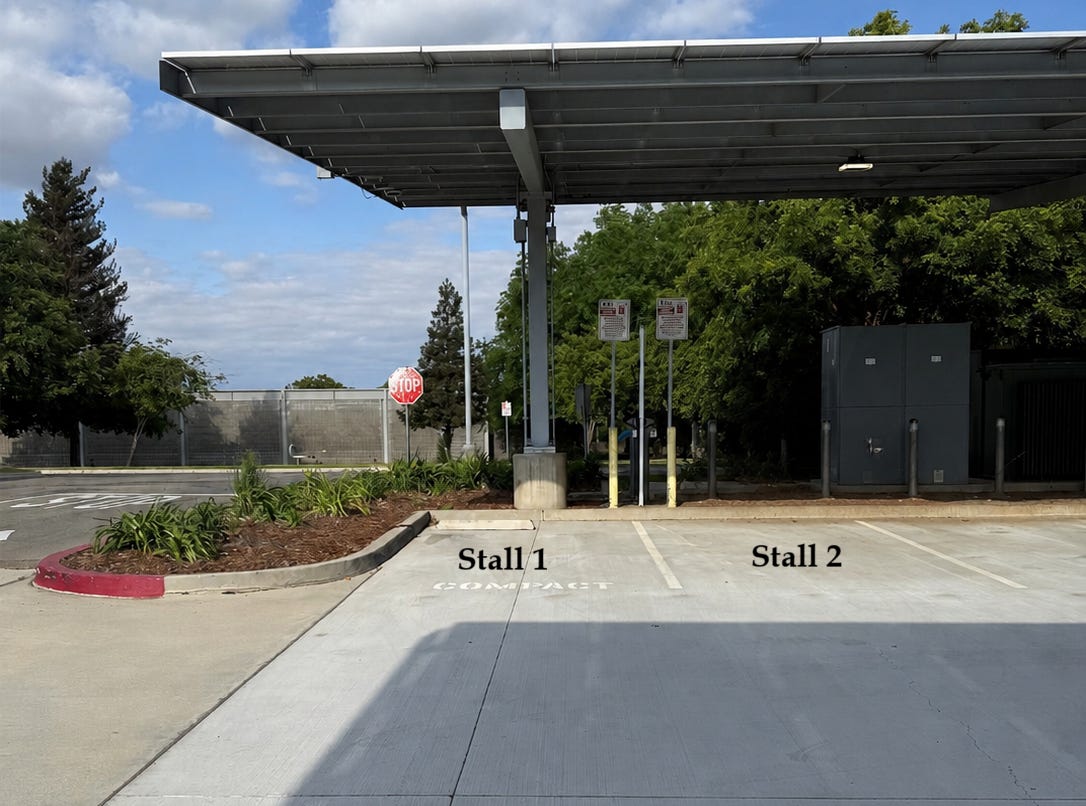
She had backed into Stall 1, adjacent to the curb. As she prepared to leave, an SUV sped toward her from across the parking lot, pulled up in front of her, and stopped at an angle with its rear bumper close to her front bumper, blocking her path out. [image below]
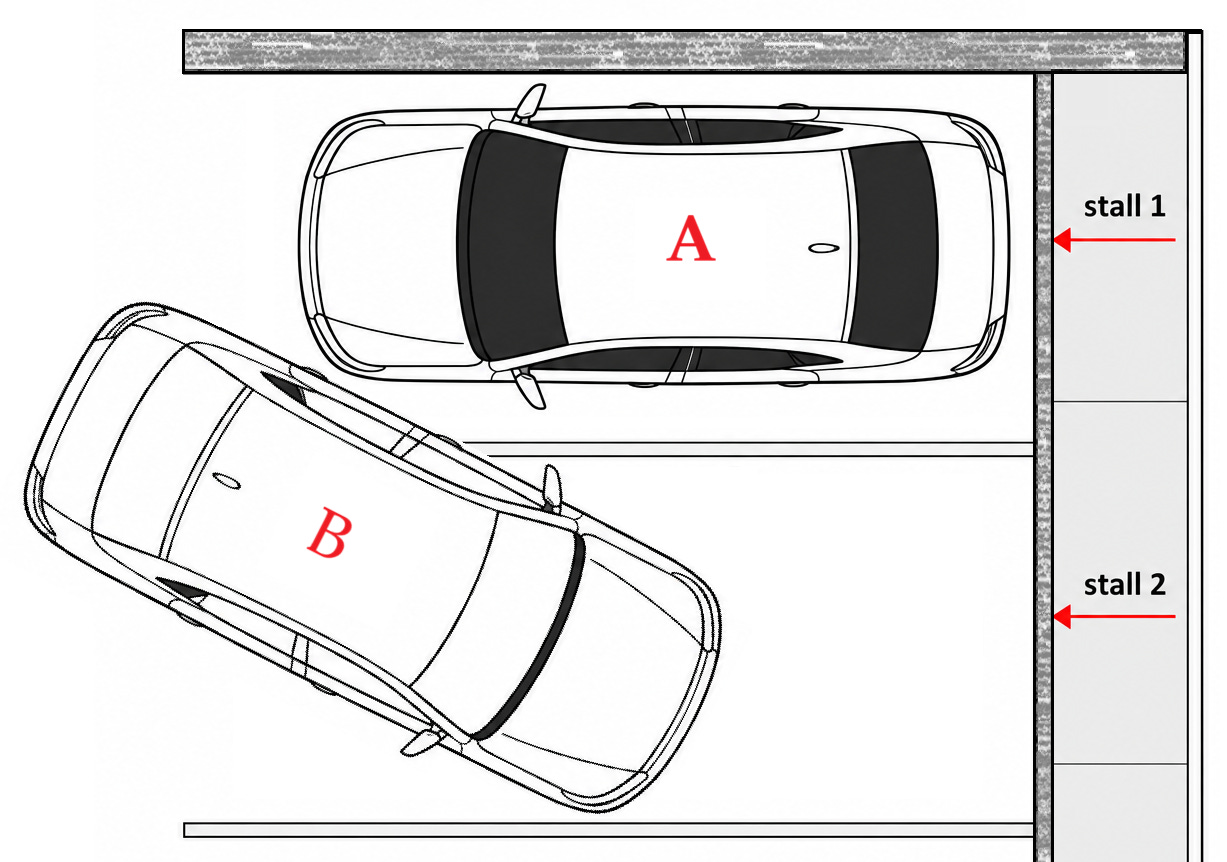
The two drivers’ windows faced each other. The driver was Mask. He rolled down his window. She rolled down hers and said:
“Bill, I need to leave.”
Mask ignored her and began ranting about the no-confidence vote the MCC Academic Senate had recently passed against Dean Justin Garcia and was in the process of drafting against President Reyna. He said the faculty involved did not “know what they were doing or what they were up against,” that Reyna was a “doer” who wanted “to get stuff done,” and that people who did not want to get on board should “get out of the way.” She asked him again:
“Bill, I need to go.”
He ignored her again and talked about how faculty are inflating a minor issue. He then said he had been assuring people that she, at least, was “doing fine.” She told him she was not fine, the situation had been extremely stressful, and she was already stretched thin. She told him again:
“Bill, I need to go.”
Mask ignored her a third time and told her how hardworking she is, how she needs help, how nobody should be asked to do so much. She told him for the fourth and last time:
“Bill, I need to go.”
Mask ignored her again. She rolled up her window. He took out his phone and stared at it, his car still angled across her exit. To get out, she mounted the curb, scraping her rim.
Mask naturally reported the incident very differently.
The colleague filed a formal complaint. The District assigned HR Analyst Joshlyn Prado to conduct the so-called “investigation” and produced no investigative report. On July 14, 2025, Reyna issued his administrative determination: allegation not sustained. Reyna noted that Mask admitted speaking with her but disputed blocking her, that there were no witnesses or video footage, and that she was able to leave. It is not clear to us how, given that she had to mount the curb to do so. Reyna also determined that there was no indication the behavior was directed at her based on protected status.
After receiving Reyna’s determination, the colleague wrote to Reyna and General Counsel Kirsten Corey explaining that she remained deeply uncomfortable and fearful on campus. [image below]
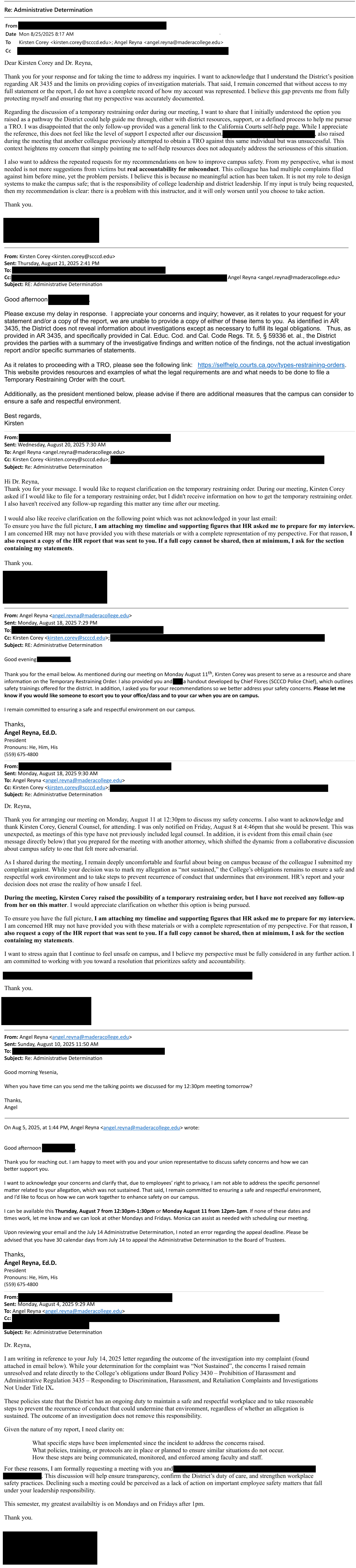
She requested the investigative report, or at minimum the portion containing her own statement, as she was concerned her account had not been fully represented. Corey denied her request. During a follow-up meeting, Corey raised the possibility of a temporary restraining order. The only follow-up the colleague received was a general California Courts self-help link, as if a frightened employee had simply forgotten how to use Google.
Then came the misdirected email. Reyna accidentally sent the colleague a message intended for Ms. Yesenia Carrillo, the District’s outside civil attorney from Liebert Cassidy Whitmore, asking:
“When you have time can you send me the talking points we discussed for my 12:30 pm meeting tomorrow?”
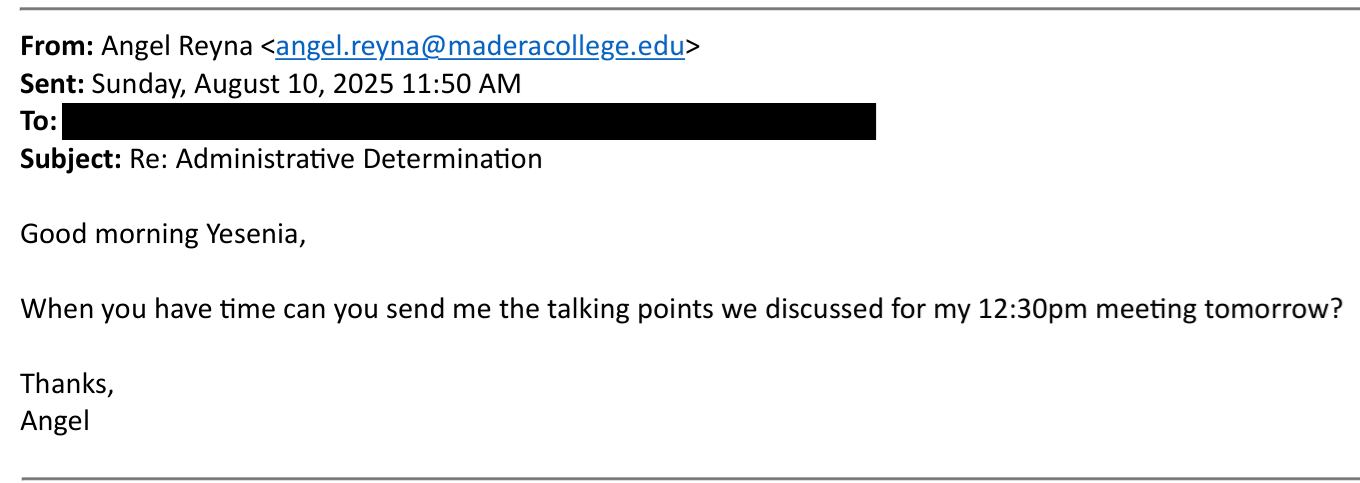
Carrillo is no ordinary outside counsel. Witnesses at Mr. Edward Madec’s criminal hearing revealed she had contacted them to discuss their testimony immediately before the hearing—conduct Madec’s attorney called “tampering with criminal witnesses” and the judge called “highly unusual.” She is also the niece of Miguel Arias, the political operative Reyna and Goldsmith hired at MCC. The uncle-and-niece duo has made delivering Goldsmith’s agenda a family affair.
The colleague did not let the misdirected email pass without comment. She replied to both Reyna and Corey:
“It is evident from this email chain (see message directly below) that you prepared for the meeting with another attorney, which shifted the dynamic from a collaborative discussion about campus safety to one that felt more adversarial.”
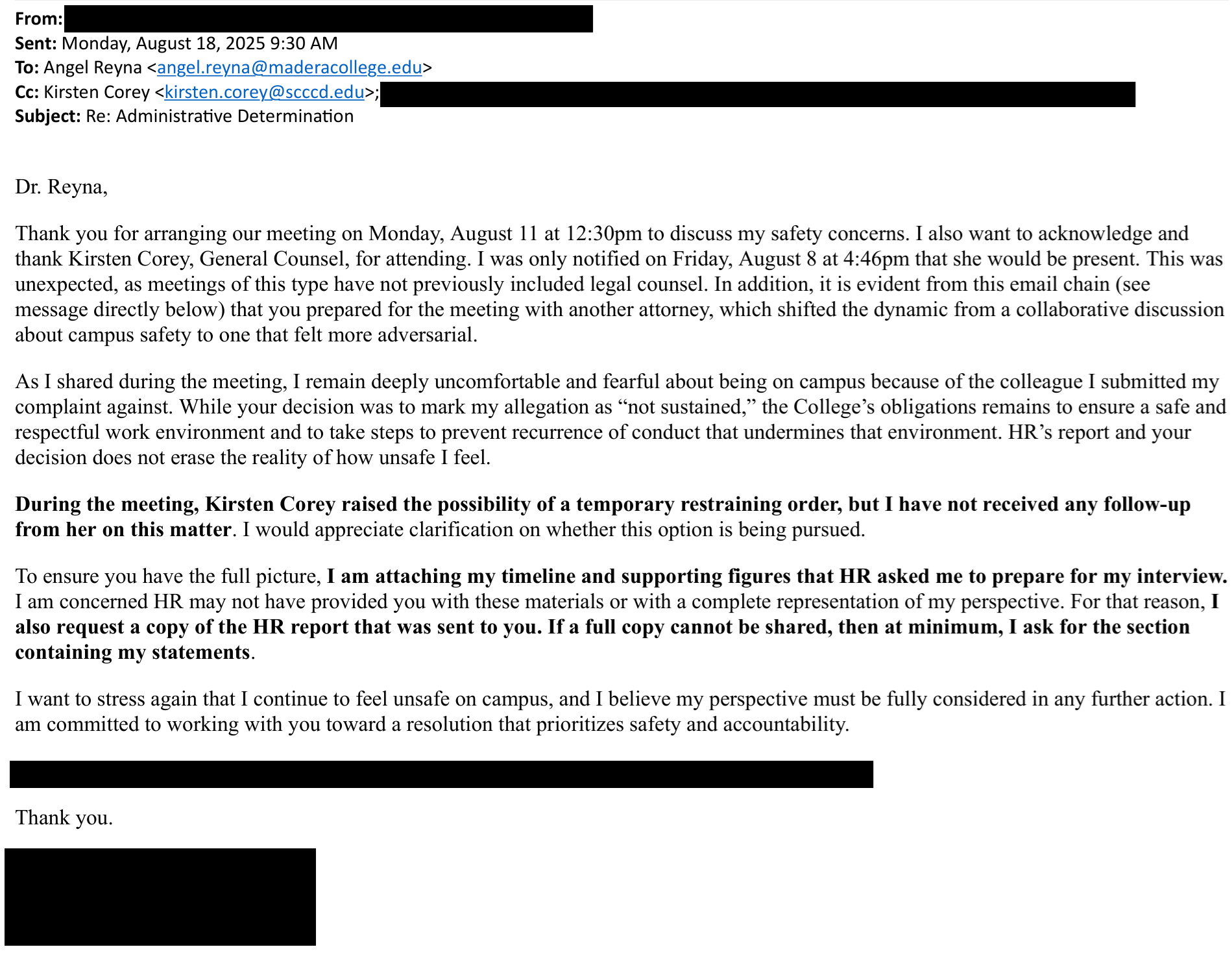
She was right. When an employee raises safety concerns about a Goldsmith ally, the District’s response is not to address them; it is to lawyer up and engage in cover-up.
If this were the only complaint, this article would not have been written.
2. Mask’s List
According to the records, in January 2023, after an Academic Senate meeting, Mask approached a female colleague who had served on the tenure committee of a friend of his. The committee had voted against the friend’s tenure. Mask confronted the colleague, telling her he intended to speak at the Board meeting. She reported Mask’s demeanor as “intimidating and threatening.” The exchange went as follows:
Mask: “You know I love you?”
Colleague: “Why are you telling me this?”
Mask: “Because on Feb 3rd I’m going to…speak in support of [name withheld].”
Colleague: “This is a personnel matter that I can’t discuss with you.”
Mask: “I respect you but what you’re doing to [name withheld] is wrong.”
Colleague: “But do you respect my work?”
Mask: “This can impact others that are on a four-year contract. I’m currently on a four-year contract and [it] can hurt me.”
Colleague: “That’s why this is a four-year process.”
She later tried to set up a meeting with Mask to discuss his approach. She described what happened next in her formal complaint:
“I was walking through AV 101 with [name withheld] and saw Bill Mask speaking to [name withheld] outside of the mailroom. I greeted both…and told Bill I would like to set a meeting to speak with him. He was open to the invite and agreed to meet. As I was walking away from the group he shouted, ‘Did you hear? None of that is happening, it’s been dropped.’ I responded by saying, ‘I don’t know what you’re talking about.’ He replied, ‘oh I have a lot to say.’ Again, his demeanor was loud, intimidating and threatening. Since I have filed my complaint, I recently learned that Bill has made comments to other faculty members that include, [name withheld] needs to be ‘taken down a peg,’ he ‘hates’ me, he wants to ‘get back at me,’ and I’m on his ‘hit list.’ His comments have created a hostile and threatening work environment.”
HR Analyst Joshlyn Prado was assigned again to investigate. The District discarded all but one allegation: that Mask created a hostile and threatening work environment by saying that the colleague needed to be “taken down a peg,” that he “dislikes and hates” her, that wants to “get back at her,” and that she is on his “hit list.”
Once the investigation was completed, no investigative report was shared with the complainant. Instead, Reyna issued another administrative determination. He noted that three witnesses confirmed Mask does keep a “list” of faculty who are “oppositional” to him, but determined the complainant was not on it, and that since no evidence showed the list was “based on a protected class,” the allegation was not sustained.
Mask’s “list” became seriously disturbing when we learned about his criminal history.
In 2007, Mask was charged with felony assault, with a special allegation for use of a deadly weapon, abuse/endangering a child with possible great bodily injury, and vandalism. The case was resolved with a no-contest plea to a single misdemeanor count of assault with a deadly weapon. [image below]
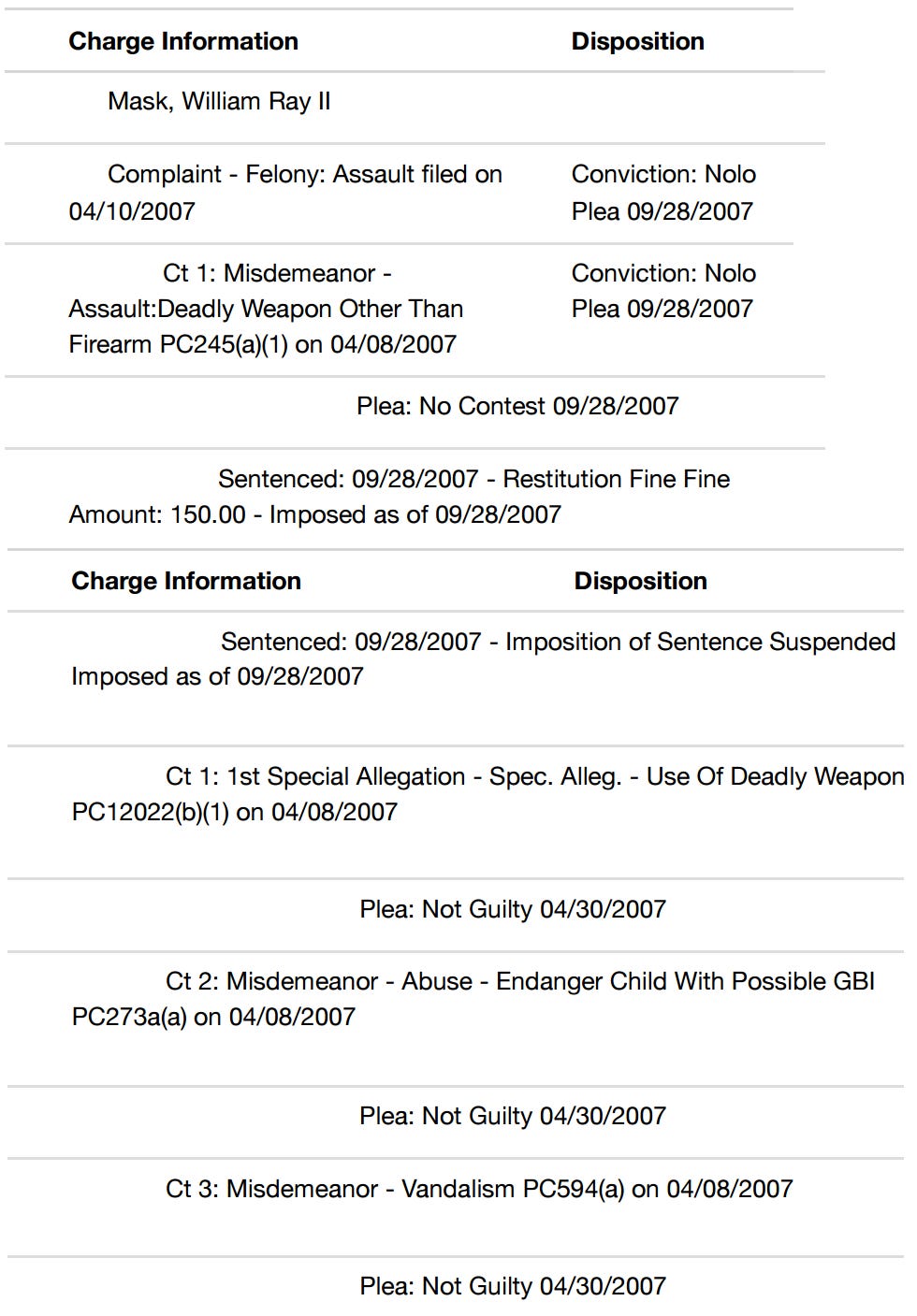
Reportedly, the charges were filed after Mask hit the victim with a baseball bat.
The same colleague continued warning the administration. She sent an email to Dean Julie Preston-Smith, Dean Shelly Conner, VP Lucia Robles, VP Marie Harris, and Vice Chancellor Julianna Mosier documenting another incident involving Mask and yet another female colleague. [image below]
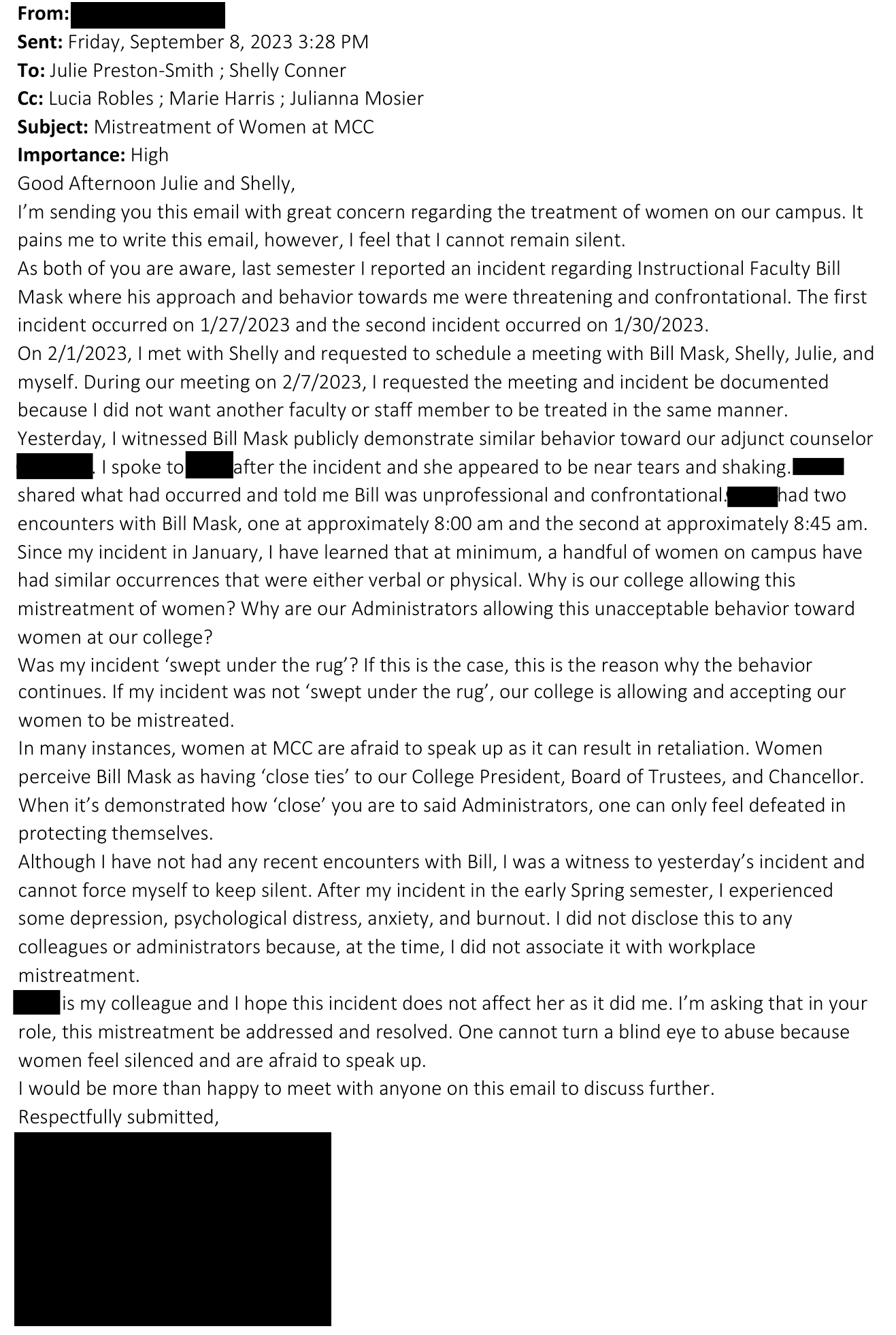
Her email asked directly:
“Why are our Administrators allowing this unacceptable behavior toward women at our college?…Was my incident ‘swept under the rug’?”
She answered her own question:
“Women perceive Bill Mask as having ‘close ties’ to our College President, Board of Trustees, and Chancellor. When it’s demonstrated how ‘close’ you are to said Administrators, one can only feel defeated in protecting themselves.”
She also filed a second complaint on September 8, 2023. This time, Christine Phillips, District Director of EEO/Diversity and Professional Development, was the assigned investigator. Again, no investigative report was produced. Again, Reyna cleared Mask.
His administrative determination found that witnesses consistently described Mask as “expressive,” “loud,” “overwhelming,” “over-the-top,” “unprofessional,” “passionate,” and “excitable.” But Reyna also determined that the conduct was not based on gender and declined to sustain the allegation.
In a second allegation that Mask’s employment was protected by his personal relationships with administrators and trustees, Reyna, the person accused of extending the protection, found that while witnesses confirmed he was “friendly” with administrators and trustees, there was “no evidence to indicate that Mr. Mask is protected in any way,” therefore not sustaining the charge—a finding issued, of course, by the same implicated party who was accused of extending the protection.
The colleague filed a third complaint documenting Mask’s continued conduct. [image below]
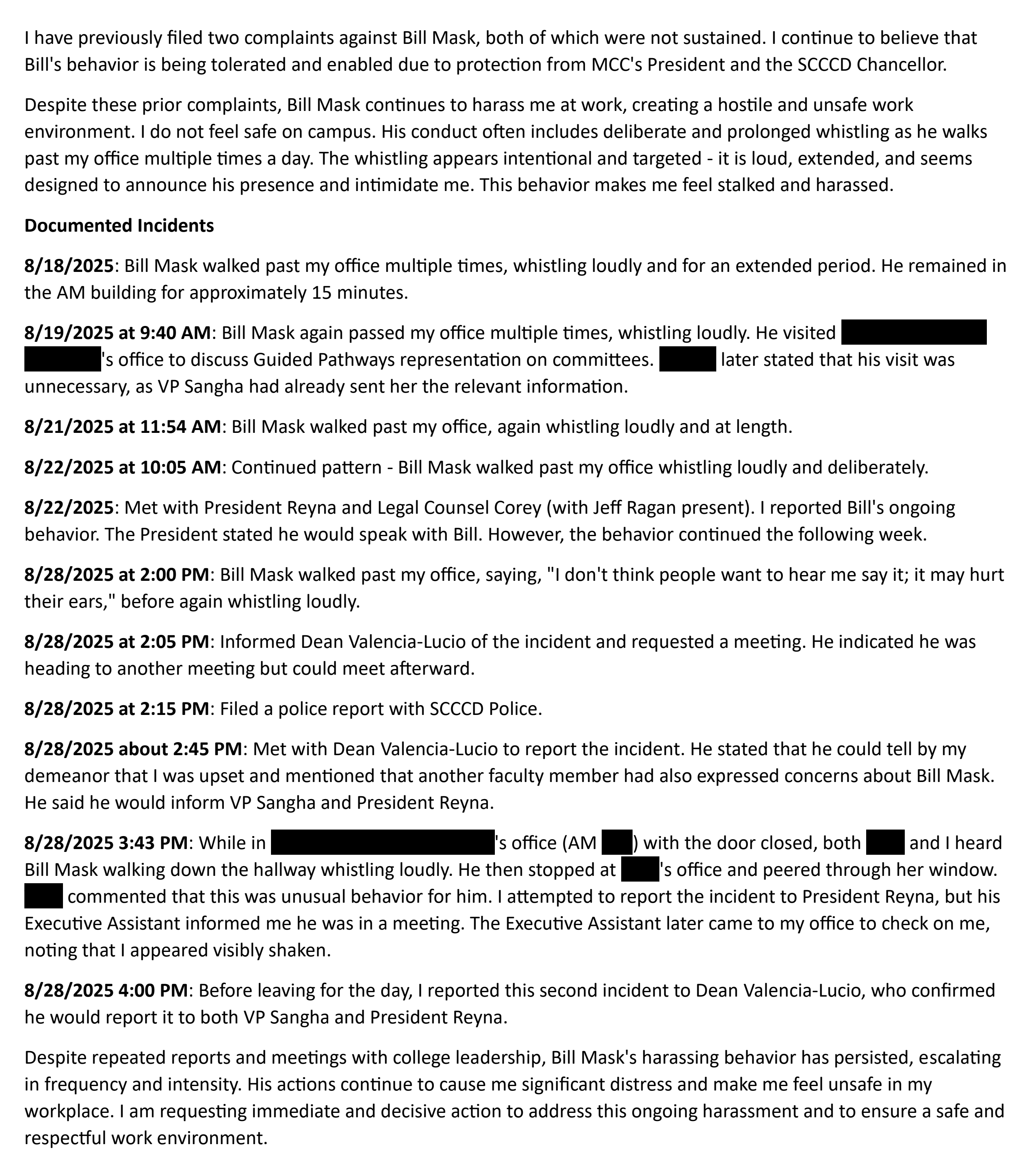
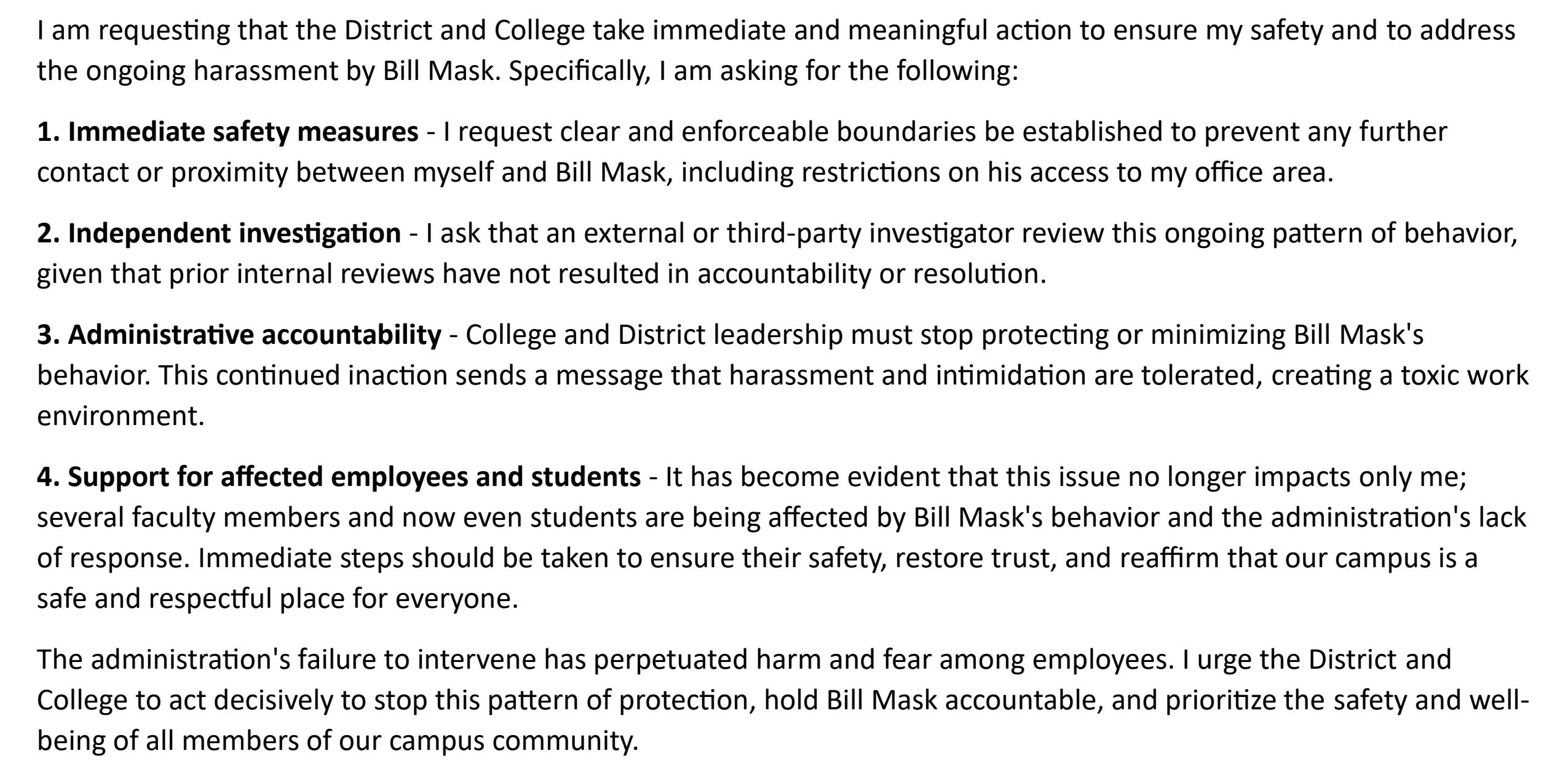
Nearly every administrator at MCC was now on record knowing about Mask’s conduct. They claimed they would address it, but his conduct continued. In her complaint, the colleague formally asked the District to act. [image below]
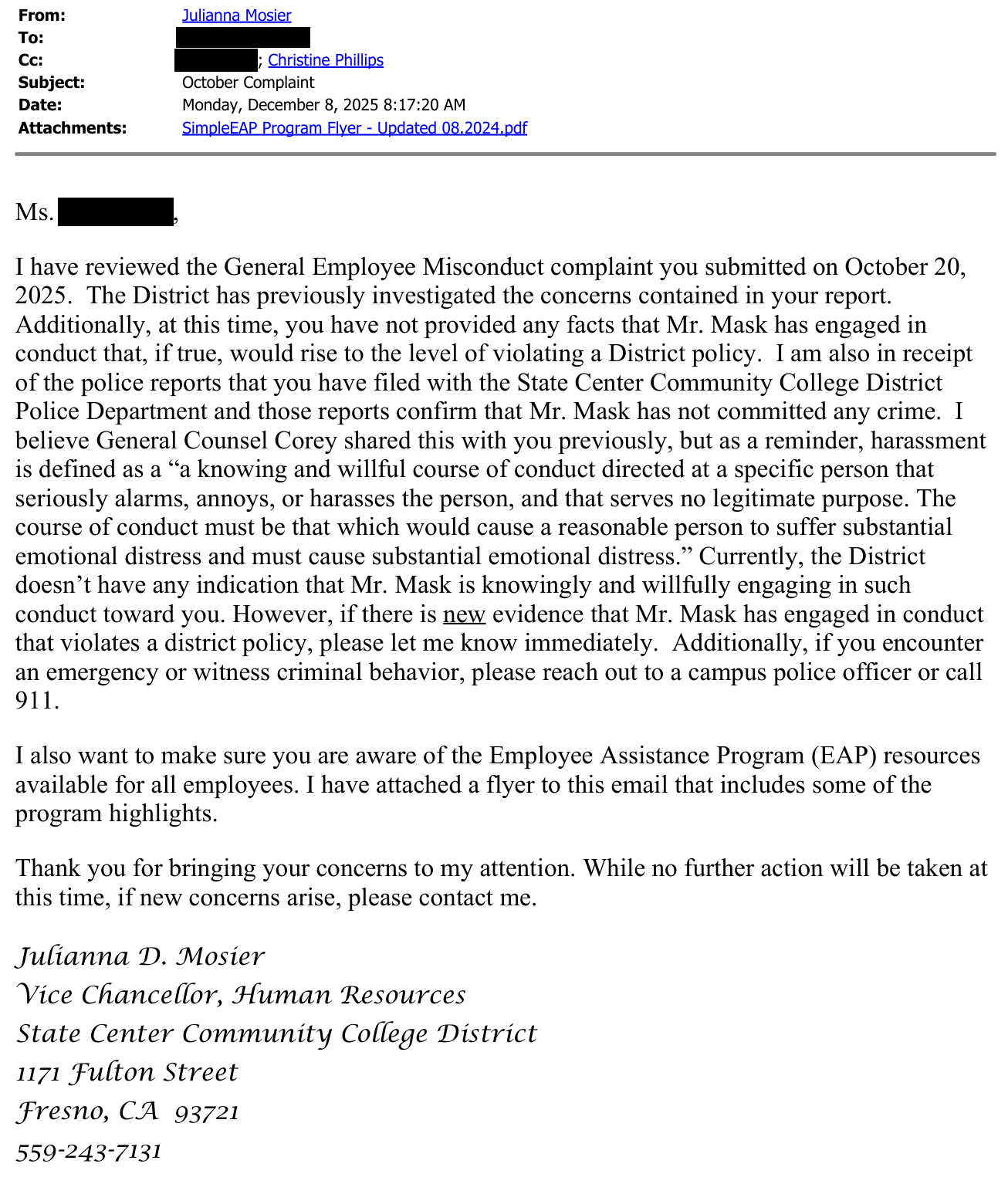
Mosier, however, summarily dismissed the third complaint without investigation. [image below]
Frustrated, the colleague filed two law enforcement reports. The first went to the SCCCD Police Department, the same department we have reported acted as Goldsmith’s personal police force in the Madec case, withheld exculpatory evidence, and now faces a federal civil rights lawsuit. The second went to the Madera County Sheriff’s Department.
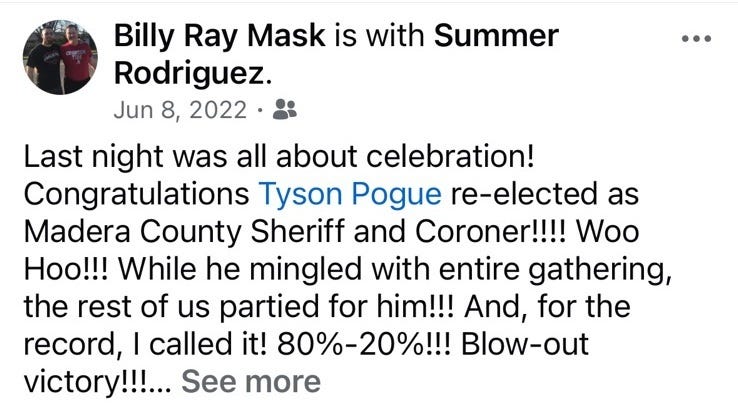
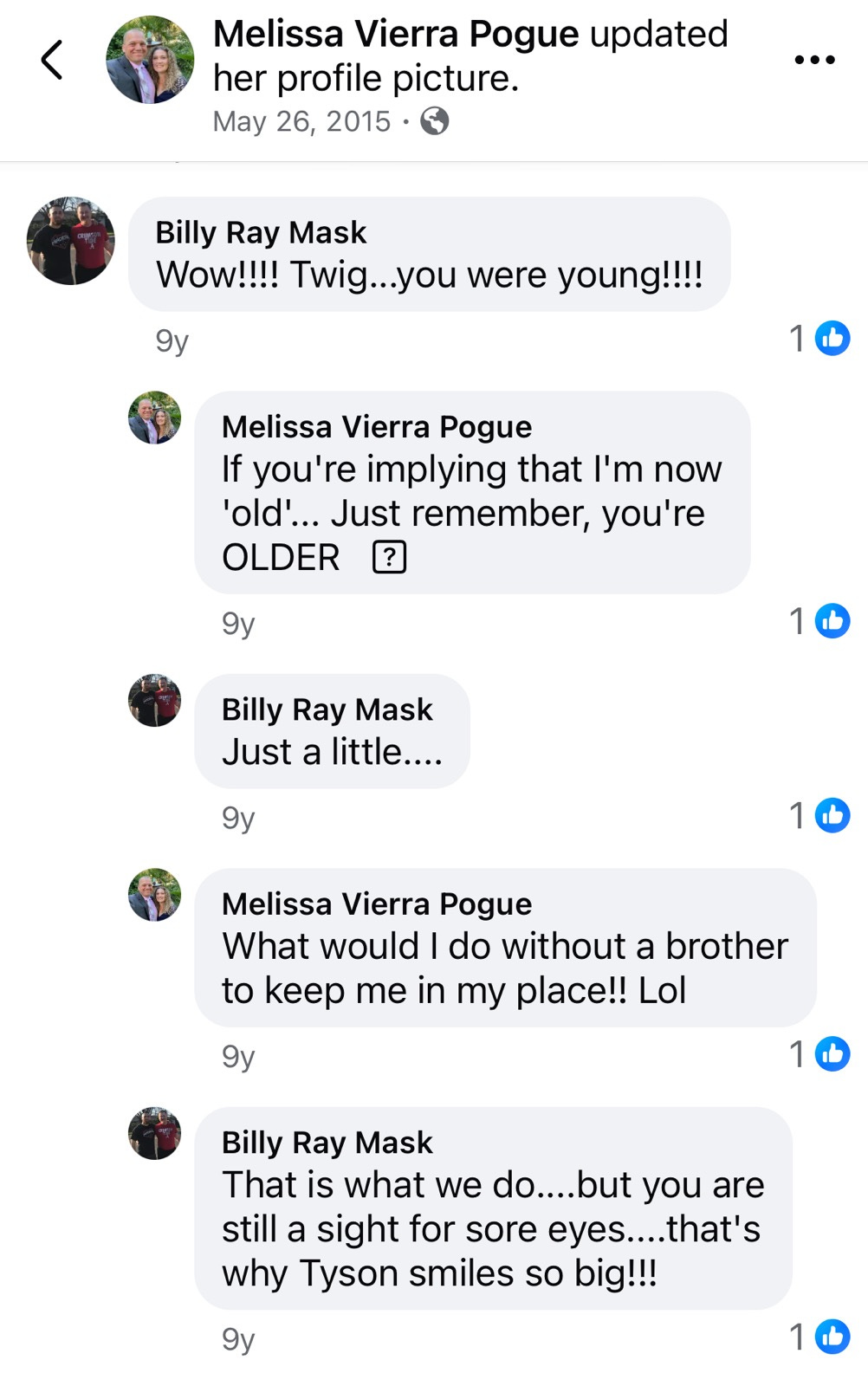
It may be unrelated, but we have learned that Mask is personally close to Tyson J. Pogue, Madera County’s elected sheriff. Mask campaigned for Pogue, attended his re-election party, and the sheriff’s wife has publicly called Mask “a brother,” a relationship documented as far back as 2015. [images below]

Both incident reports were dismissed, and Mask’s conduct continued.
3. Mask’s Event
According to records and witnesses, on Monday, March 27, 2023, a female colleague texted the following to her group chat, verbatim and in real time:
“OHHHH HE’S YELLING ON THE PHONE TO PRESIDENT REYNA. HE’S stamping HIS FEET. Yelling about he served his country. Holy shittttttt he walked away but his voice is echoing. Y’all I’m just in the back corner scared… I have literally never seen him this enraged it is scary.”
By the accounts of colleagues nearby, Mask raged into the phone for thirty to forty-five minutes. On the other end of the line was Reyna. The subject, according to those same accounts, was a female classified professional who, in Mask’s view, had not handled paperwork for his event correctly. Another colleague drove across campus and positioned herself near the scene, in case the moment needed defusing. A third colleague, having heard the yelling, came to find the original female colleague physically shaking.
The women around Mask had learned to warn and physically protect one another. The fact that they had to develop a routine for protecting one another from a colleague’s rage is appalling. The man frightening them had a direct line to the president and chancellor, and both kept it open. That is the access at the heart of this story.
This was not the only time Mask’s volume or yelling frightened his colleagues into hiding. The next time, it also scared at least one student.
4. Mask’s Pain Meds
According to records, on January 16, 2024, Mask stood outside MCC’s AV1 building screaming into his phone at the Veterans Affairs (VA) because he hadn’t received his pain medication. He was screaming loud enough to disrupt nearby offices. Multiple colleagues documented it in real time:
Sender 1: “Bill Mask is SCREAMING outside. He’s having a shouting match on the phone… He is legit scary when he’s mad and does not manage his emotions.”
Sender 2: “VA hasn’t sent his pain meds.”
Sender 1: “I guess that makes sense but you honestly can’t be screaming like that at a school.”
Sender 2: “Nope. It was really bad. The tone was hateful. Scared the hell out of me until I recognized his voice. Scared at least one student.”
Sender 3: “100% scary! I was there when he popped off once. I understand the pain meds situation but also remember how gentle we need to be going about that with others’ traumas around us and everything going on. I bought a first aid/survival kit to keep in my bag with a couple other things cuz you never know.”
Administrators had to be called to calm him down.
The complaints went far beyond screaming.
5. Mask’s Hugs and Kisses
According to records, at a spring 2025 campus LGBTQ+ event, Mask hugged a female colleague who was visibly uncomfortable; she did not tell him to stop because she did not want to escalate the situation. She later said she wished she had. Mask had also kissed the top of her head without her consent on at least two prior occasions.
In March 2025, this colleague went to the SCCCD Police Department to document a non-consensual kiss. She requested that no charges be filed because she did not want to escalate the situation with Mask further, but she wanted the record to exist to support others who had experienced what she described as his recurring inappropriate and dangerous behavior. Women recognized that to protect others in the future, they needed to create a paper trail of what happened to them.
The District took no action.
6. Mask’s Language
Across the record, women describe a recurring vocabulary. Mask called one faculty member his “girl Friday,” a dated term for a female assistant. He nicknamed another female colleague “smiley.” He referred to female faculty collectively as “girls.” He commented on one female colleague’s appearance, telling her she looked “tired and a mess” and was “showing grays.”
Any one of these, by itself, is the kind of remark an institution waves off. Aimed where they were aimed, and as often as they were, they are a pattern.
A pattern the District intentionally ignored.
7. Mask’s Yelling
According to the records, on September 9, 2024, Mask entered the office of a female Academic Senate officer and, within a minute, began yelling. He was angry about a committee assignment he believed he deserved, accused her of being complicit in “blackballing” him from leadership, and yelled for ten minutes before storming out.
She reported it to VP Harris two days later this way:
“At 11:50 Bill Mask entered my office space to talk to me about hiring committees. After about a minute, he started yelling about not being given the committee assignment he felt he deserved from the Academic Senate. Despite my repeated attempts to defuse the conversation, he continued to rant about how I was complicit in blackballing him from leadership. He yelled for a good ten minutes before he stormed out of the room.”
Later that day, she told Mask that if a student had spoken to her that way, she would have called campus police. Mask said he was “just loud” and “not yelling at” her, just yelling. She told him the behavior was unprofessional and unacceptable. Mask apologized and said it would not happen again.
Less than an hour later, he emailed the entire Academic Senate Executive Council demanding to know why he hadn’t received the committee assignment and why he had been “blackballed.” The apology for unprofessional communication survived only forty-five minutes.
The Senate officer reported the incident to VP Harris on September 11, the same day that Bill Mask yelled at another faculty member “to the point of spitting” about the no-confidence resolutions.
Two days later, on September 13, the day the Senate met for the first reading of the no-confidence resolution against Garcia, Mask entered the corridor outside the Senate chambers and announced:
“I just got off the phone with Carole. She’s going to mess with [name withheld]’s tenure.”
Let that sink in. A faculty member with no role in personnel decisions claimed to have just spoken with the Chancellor about a colleague’s tenure and predicted, specifically, that it would be “messed with.”
Three months later, to the day, his predication became reality.
Mask continued to tell people about what he knew. On October 21, the colleague documented it in an email to VP Harris:
“He has been telling anyone and everyone that my work with academic senate is going to cause me to be fired and that Carole herself is threatening my tenure. Every time he tells another person this, they come to me. I have had at least 6 people come and tell me that he has sought them out to tell them this. I am starting to feel harassed and am contemplating filing an HR complaint.”
As we have reported, on December 13, 2024, VP Marie Harris denied the Senate officer’s tenure despite the other two committee members recommending approval. Reyna concurred. After grievances and advocacy from the faculty union, the Board of Trustees reversed the denial, unraveling Goldsmith’s plan.
On November 14, 2024, the Senate officer filed the HR complaint she had promised. Once again, no investigative report was shared with her; only Reyna’s administrative determination declaring there was no evidence of a “power differential” giving Mask influence over her tenure and no evidence he was “privy to any confidential information.”
This was gaslighting at its worst. Either a tenured history instructor with no formal role in personnel decisions made a wildly specific prediction three months in advance and was proven exactly right by coincidence, or he knew, because he was close enough to have been told. You decide.
Reyna did sustain, in part, that Mask violated the District’s values when he yelled at her in her office. He found the conduct did not reflect the District’s value of “kindness.” We disagree. That is exactly the brand of kindness Goldsmith has promoted at SCCCD.
The pattern continued into 2025. At a January 10 Flex Day joint presentation between the Academic Senate and faculty union, Mask interrupted the same Senate officer as she added context to a response, cutting her off loudly with:
“I’m not talking at you.”
The faculty in the room audibly reacted. A department chair told Mask to stop, adding his conduct was inappropriate and unnecessary. A witness described the moment as part of a broader pattern: immediate escalation from conversation to rage, often to the point of spitting while yelling. One of Mask’s prior yelling fits had been severe enough that people believed there could be a campus shooting.
Reyna sustained that Mask’s Flex Day conduct was “disrespectful” but, as always, found insufficient evidence that it was based on protected status—once again clearing his proxy.
8. Mask’s Matchmaking
According to the records, on April 9, 2025, Mask came to a female colleague’s office and told her that a student “likes you,” implying a romantic interest. The colleague told him the relationship was strictly mentor-student and that the comment was inappropriate. Mask responded:
“You know down the line, in a few years, when… [they’re] not a student anymore that is okay and you never know.”
She told him no, that would never happen, and not to say anything like that again.
Months later, the colleague learned that Mask had been calling and texting the student without response. When she checked in with the student, the student said they had not responded because Mask had made comments that made them uncomfortable. Mask had told the student that when they were no longer a student “then it is okay,” and that “there is a good friendship” between the faculty member and the student, which is “a foundation for a good relationship.”
On September 4, 2025, Mask visited the colleague’s office to congratulate her on tenure. He said it was nearly impossible to fire a tenured professor and that it would take “selling drugs or having sex with a student.”
A faculty member who had been encouraging a romantic relationship between a colleague and her student then described sex with a student as the threshold for termination. The District should not need a legal microscope to see the problem.
9. Mask’s Protection Maze
Again and again, SCCCD treated the absence of a perfect legal finding as permission to avoid meaningful correction.
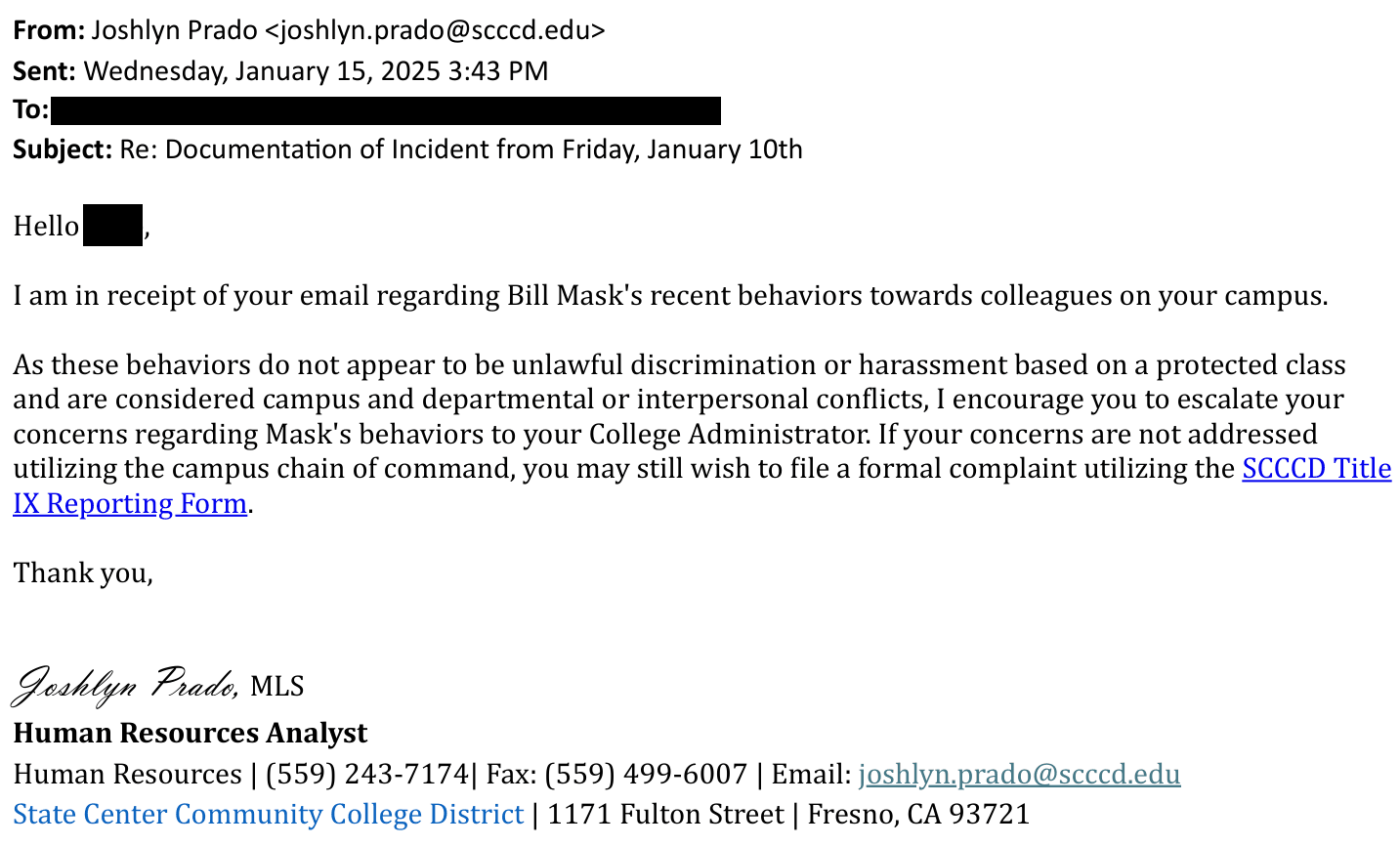
One of Mask’s female colleagues reached out to Mosier’s office, specifically HR Analyst Joshlyn Prado, to report the Flex Day incident. She told Prado what happened at the session and added:
“I was genuinely frightened of him becoming violent due to his rage. ... his immediate escalation and aggression on January 10th is an ongoing and extensive pattern of behavior over years, not an isolated incident.”
That statement deserved a serious response. Instead, Prado minimized Mask’s conduct in her response when she said:
“[the] behaviors do not appear to be unlawful discrimination or harassment based on a protected class and are considered campus and departmental, or interpersonal conflict.”
She then encouraged the employee to escalate to a college administrator. [image below]
The witness pushed back. She cited AR 3430’s hostile-environment language, explained the pattern involved aggressive behavior toward women, and noted that Mask appeared to feel entitled to behave this way because of his relationship with administrators at the vice president level “and above.” She stated plainly that she was not comfortable escalating to those same administrators. [image below]
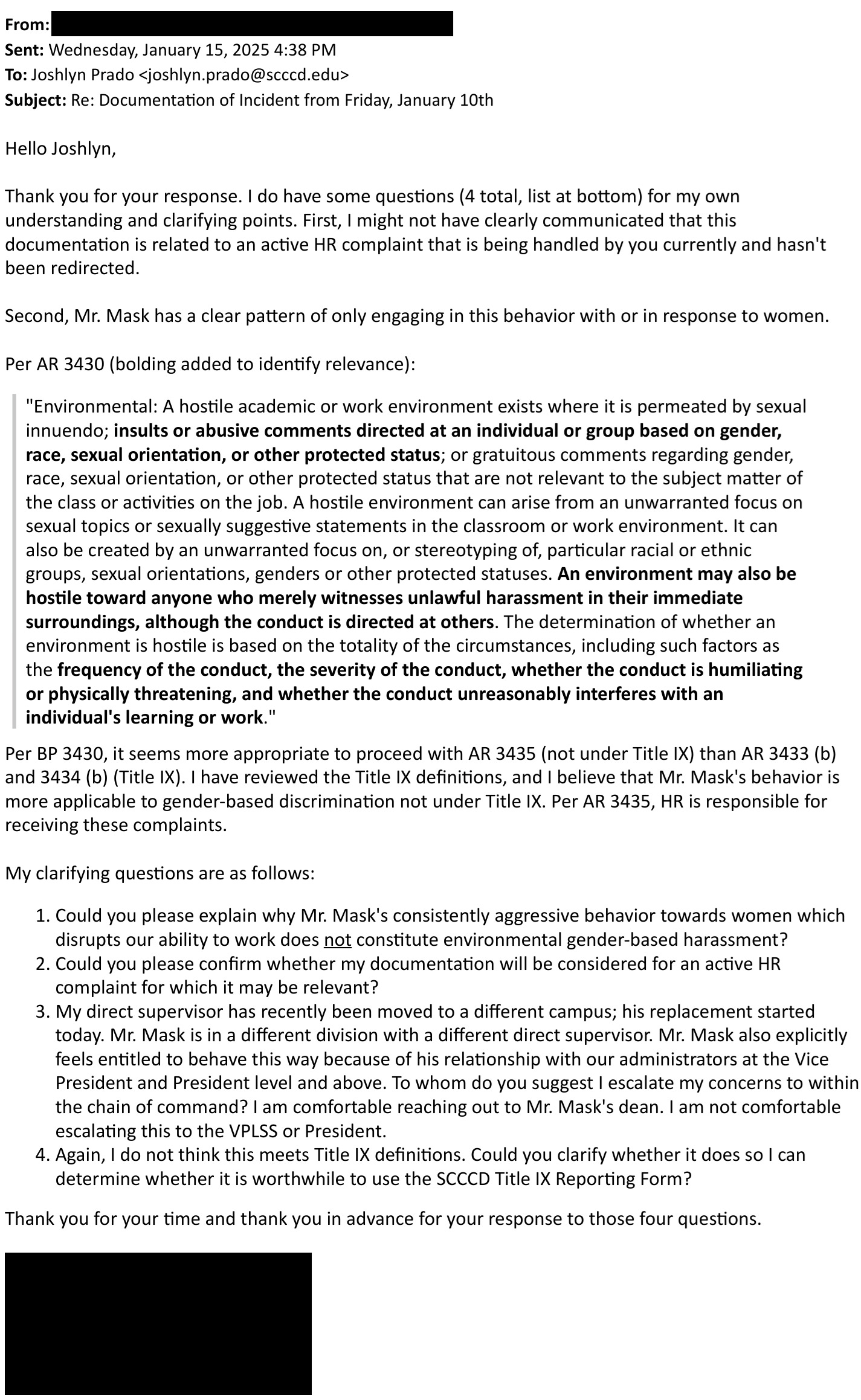
She also asked a direct question:
“Could you please explain why Mr. Mask’s consistently aggressive behavior towards women which disrupts our ability to work does not constitute environmental gender-based harassment?”
What happened next is the maze.
Despite her express written request that her concerns not be filed as a Title IX complaint, Christine Phillips and Joshlyn Prado filed one on her behalf anyway, then promptly dismissed it. She was reclassified as a mere “witness” in another employee’s complaint, required to sit for roughly two hours of questioning, and made to submit twelve pages of documentation about what Mask had done to her, only to watch the matter be disposed of.
In her own words to President Reyna, written more than a year later:
“Despite requesting that it not be submitted as a Title IX complaint, Christine Phillips and Joshlyn Prado violated my consent and submitted one on my behalf, then immediately denied it.”
Prado works under Phillips, who works under Mosier, who works under Goldsmith. The chain of command that was supposed to protect all of these employees was the same chain burying their complaints to protect Mask.
10. Mask as Proxy
We have written before about administrators whose conduct should have ended their careers and did not, because Goldsmith protected them. In “Protected Malfeasance,” we documented Dr. Jodette “Jodie” Steeley, the District Director whose decade of toxic conduct at Fresno City College was rewarded with a position Goldsmith invented for her. Vice Chancellor Robert Frost—“the Henchman”—operated for years with the same impunity until he was finally escorted off the premises by District police on March 5, 2026. Dean Cyndie Luna imposed a mandated textbook scheme she personally benefited from, one that reached nearly every student at FCC. She was not only protected but rewarded with expedited and increased SCCCD contracts to her husband’s store, First String Sports. Goldsmith herself funneled $161,000 in no-bid contracts to her unqualified goddaughter without consequence.
The pattern is consistent: the closer the relationship to Goldsmith, the less the conduct matters.
Mask is a variation on the pattern. He does not supervise the faculty he affects. He does not need to. He sits in their meetings, votes in their elections, advises their student government, coordinates their program reviews. And he is closer to the administration than any ordinary instructor in his position has reason to be.
On September 4, 2024, at an MCC “Pizza with the President” event, Mask leaned in to a colleague and whispered: “I have information you want.” The next morning, the colleague emailed to ask what he meant:
Colleague: “Hey Bill, what did you want to tell me during yesterday’s pizza with president?”
Mask: “This ‘ag’ program is about to go boom. Loads of community members wanting to get involved.”
Colleague: “Yah the president said he has the county backing him up. He has a lot of support. I wish him well.”
Mask: “Are you excited? The possibilities…are crazy good.”
Colleague: “How so?”
Mask: “The will be incredible.”
Colleague: “What will that money go towards? Why hasn’t president Reyna shared this with the campus community?”
Mask: “Still a lot of moving pieces. But all starting to fall into place. He cannot share until community alignment and funding received/guaranteed.”
A history instructor with no faculty leadership position in the Academic Senate or union was previewing the college president’s program funding strategy, including Reyna’s rationale for keeping it from the campus community. Mask did not say where he got the information. He did not need to.
The records point to the source.
In August 2024, a week before the pizza event, VP Harris told an employee that she had met with Goldsmith, Reyna, and Mask several times. The reason, Harris explained, was that Mask was speaking publicly against the administration’s planned allocation of Measure Q funds. The administration “felt that Mr. Mask’s personal familiarity with local politicians and board members meant that they needed to manage his local power and what he was saying about Measure Q.”
Sit with what that is. While women were documenting their fear of Mask, the administration’s stated concern was not his conduct toward his colleagues. It was his “local power,” and the need to manage it.
Then, as Academic Senate no-confidence activity against Garcia and Reyna intensified, Mask confronted female colleagues tied to Senate leadership and to criticism of the administration.
The Chancellor, the president, and the vice president were not treating Mask as an ordinary instructor. They were treating him as a proxy—leverage against faculty, and a bargaining chip with the community.
Reyna acknowledged in writing that Mask is “friendly” with administrators and trustees, then cleared him of the very charges that those friendships were shielding him. But the documented conduct points far past “friendly” to something reciprocal. For at least three years, Goldsmith, Corey, Mosier, Phillips, Prado, Reyna, and Harris handed Mask one not-sustained finding after another. In return, Mask worked the hallways to defeat the no-confidence resolutions, drummed up support for the doomed AgTEC CBE program, and advocated for the Agave program. He defending, every time, the same administrators who sat in judgment of the complaints against him. The complaints failed. His conduct escalated.
History has names for the figure who sits inside a group while working against it: the company man, the stool pigeon, the Pinkerton, the quisling, the fifth columnist. A proxy does not announce himself, and he does not issue orders. He occupies the room, gathering information, influencing colleagues, intimidating the ones who resist, defending the administration, and drawing its protection in return. Seen that way, the District’s inaction stops being a puzzle. Why would Goldsmith and Reyna stop a man who was doing exactly what they wanted?
On February 26, 2026, Mask made the proxy question impossible to ignore.
In an email announcing his candidacy for MCC Academic Senate President-Elect, Mask told a select group of colleagues that he had been unhappy with the Senate for more than two years—the same stretch in which the Senate had been under sustained assault by Goldsmith, Reyna, Harris, and other administrators. He accused the Senate Executive Council of abandoning collegiality, professionalism, and respect, and claimed the campus had become a “shell” of itself, its “family-based community aura” replaced by “dissent, chaos, frustration.”
Then came the heart of the pitch:
“My track record is proven! I have worked successfully with administration, classified professionals, local organizations, local politicians, and District leadership. This track record spans over a decade.”
A few lines later, he wrote:
“The odds are heavily stacked against me. The power click [sic] is deeply engrained.”
He warned of an entrenched “power clique.” He should know what one looks like. But the entrenched power at MCC has never been the Senate’s faculty leaders; it has been the administration, and Mask was running as its candidate, campaigning against the colleagues who had challenged it while offering his decade-long relationship with it as his chief qualification. He promised to “flip the narrative.”
That is the point.
Faculty bodies exist to represent faculty, not to rehabilitate administrative narratives. Academic Senate leadership is not a customer-service desk for presidents and chancellors. It is supposed to be an independent voice in shared governance, especially when administrators overreach.
Mask’s email reads less like a faculty platform than an administrative counterinsurgency memo in faculty clothing.
11. Mask’s Cost
The women in these records are not fragile. They are the people who keep MCC functioning while administrators preach “kindness” and “grace,” and retaliate against them in the same breath. What they described to the District is not discomfort with disagreement or a difficult colleague.
It is fear.
They described fear of a man with an assault conviction and an explosive temper. A man who keeps a “list.” Who screams at colleagues to the point of spitting. Who tells them they should be “taken down a peg.” Who says he wants to “get back at” them. Who touches women without their consent. Who ignores repeated requests to move and let them leave. Who appears to target women disproportionately, enough that some hid in back corners, some carried mace and survival kits to campus, and others drove across campus to position themselves nearby, just in case. Who frightened at least one student. Whose rages were severe enough that people feared a campus shooting.
They described filing police reports, requesting police presence at Academic Senate meetings, suffering stress-related physical symptoms, being drawn into inappropriate conversations, and feeling unsafe at work. At least one has left the college. Others are considering it.
None of this is normal. None of it was addressed.
The District’s response followed a now-familiar pattern. Investigate narrowly. Withhold the investigative report. Isolate each incident from the broader pattern. Decline to sustain any charge because the conduct was not “based on a protected class.” Then watch the pattern continue. Each dismissal protected Mask and left the women who reported him with nothing—no accountability, no safety plan, no meaningful correction. Reverse the roles and the machinery runs the other way: when the complainant serves Goldsmith, the investigation expands and the charges are sustained regardless of the facts, as in the VP Harris complaint against SCFT President Keith Ford.
This is the human cost of Goldsmith’s leadership and her two-tier system in our District. One standard for those who serve her. Another for those who do not.
Make no mistake: the Board is complicit. Mask was in contact with trustees whom we will soon identify. The Board continues to inflict pain on our District, our colleagues, and our students by shielding and enabling Goldsmith and her cronies.
The remedy starts at the ballot box. We need to reshape this Board by backing and electing trustees who answer to the public that elects them rather than to the chancellor they are supposed to oversee. Until that happens, even a new chancellor will not change anything. The Board is the head of this District and a fish rots from the head.
We leave you with a reminder of our golden rules:
Do not disparage us, faculty, or classified professionals.
Do not retaliate against anyone who speaks up.
This article is based on records reviewed by The SCCCD Insiders, including witness accounts, formal complaints, administrative determinations, law-enforcement records, court records, and contemporaneous communications. The misconduct described here are alleged. The editorial analysis, interpretation, and conclusions are our own, based on the records available to us. Nothing in this article should be read as a finding of criminal liability, civil liability, or professional misconduct by any court, agency, or tribunal unless expressly stated. Mr. William “Bill” Mask is entitled to the presumption of innocence as to any allegation that has not been adjudicated. We include the District’s repeated decisions not to sustain these complaints so that readers have the full record. We publish this story because the documented concerns involve serious workplace safety, institutional accountability, public governance, the handling of employee complaints, and the conduct of public employees and administrators within a taxpayer-funded community college district. These are matters of public concern.