
Protected Malfeasance
District Director Jodette Steeley


If you’re reading this in your email inbox, this article is too long to display in full. Click the button below to read the complete version online.
Images and PDFs are marked with [image below] and [PDF below] so listeners using the Substack app know when to glance at their screen.
For more than a year, we have documented a simple truth about the State Center Community College District (SCCCD): misconduct rarely survives on its own. It survives because someone protects it. Someone excuses it. Someone promotes it. Someone decides that loyalty matters more than competence, that control matters more than consultation, and that the damage done to faculty, students, and staff is an acceptable loss.
This article is about Dr. Jodette “Jodie” Steeley, the District Director of Distance Education and Instructional Technology. It is about protected malfeasance: a long record of complaints, overreach, adversarial communication, hostility, misrepresentation, poor leadership, and operational incompetence that should have triggered serious administrative intervention years ago. Instead, Steeley was protected, then elevated. The result was predictable. A problem once localized at Fresno City College (FCC) was exported districtwide.
Sources consistently attribute the protection Steeley enjoyed to two relationships. The first is the reported on-again-off-again romantic relationship between Steeley and now-CTO Don Lopez during the years he directly supervised her as FCC’s Vice President of Instruction. The second is Chancellor Carole Goldsmith’s reliance on Steeley as an informant and operative—someone whose loyalty to Goldsmith mattered more than the damage she caused.
When Steeley’s incompetence and toxicity became politically and operationally untenable at FCC, Goldsmith did not solve the problem. Instead, she prevented President Pimentel from issuing the non-renewal notice that would have ended Steeley’s tenure. She then moved Steeley into a conjured-up position at the District Office and, finally, to justify the position, handed her centralized control over Canvas, the instructional system used across SCCCD, all without consulting with the Academic Senates, of course.
What followed was predictable. Steeley’s incompetence and malice resurfaced, this time districtwide. Local control of Canvas was stripped, faculty expertise was dismissed, and chaos spread. When the consequences became impossible to ignore, the cover-up began and the explanations shifted.
This article documents three connected failures: Steeley’s long-standing pattern of conflict with faculty, Don Lopez’s and Carole Goldsmith’s protection and elevation of her, and the districtwide disruption that followed when Steeley’s proven poor judgment was handed control over Canvas.
We will address the later formal faculty votes of no-confidence in a separate article. Here, we focus on the conduct that made those actions inevitable.
1. FCC Saw the Pattern First
Long before Steeley became a districtwide problem, she was already an FCC problem.
Steeley was hired at FCC in July 2016 as Director of Distance Education and Instructional Technology by the then-Vice President of Instruction, Don Lopez, now the District’s Chief Technology Officer (CTO). The position was a campus-level role, supervised by Lopez, with responsibility for FCC’s Distance Education (DE) program.
Within months of her hiring, faculty began raising concerns about Steeley’s conduct, her communication style, and her understanding of the limits of her administrative authority. She treated the title “Director” as a personal warrant to control DE decisions that belonged to the Academic Senate. DE primarily implicates academic and professional matters within the Academic Senate’s 10+1 purview. Sources and records indicate that Steeley either never understood that boundary or refused to respect it. While her direct impact was initially concentrated at FCC, some of her decisions still had districtwide consequences, producing conflict with Instructional Designers, DE Coordinators, and Academic Senate leaders across SCCCD. When faculty pushed back against her decisions, she became extremely hostile, bullied them, and retaliated against them by leveraging her relationship with Lopez.
The documentary record from FCC confirms that serious concerns about Steeley were not new.
In Spring 2021, the Fresno City College Academic Senate Executive Board drafted a Memo of Concern titled “Failure of the Director of Distance Education to maintain collegial and professional coordination and collaboration with the Academic Senate.” The memo stated that, during Spring and Fall 2020, the Executive Board of the Academic Senate had received complaints from faculty “across the campus and district” about Steeley’s unprofessional behavior, as well as questions about her duties, responsibilities, and authority in relation to faculty’s 10+1 purview.
The same memo identified the core concern as overreach. It stated that the Director’s assumed authority touched curriculum, grading policies, educational program development, standards, and student preparation and success, all of which fall under the Academic Senate’s purview.
It then identified six categories of concerns, including “no coordination in Spring 2020 during the emergency transition to online classes,” “lack of professional honesty,” “disparaging remarks about faculty,” “lack of communication regarding faculty training,” “unprofessional communications,” and “overall disregard of faculty purview in academic and professional matters.”
The formal vote was paused at Goldsmith’s request during the COVID emergency. Something was likely said about “extending grace.” The concerns were not resolved. They deepened.
Sources across the District describe Steeley’s leadership style in strikingly similar terms: adversarial, abusive, hostile, controlling, deceitful, incompetent, dismissive of and hostile to faculty expertise, impossible to work with, quick to assign blame, and unwilling to accept the Academic Senate’s role in academic and professional matters. Multiple sources described a pervasive culture of fear, intimidation, and retaliation around those who challenged her decisions and told us she perpetuated a hostile and destabilizing work environment.
We do not use those descriptions lightly. Nor do we pretend that every workplace conflict proves misconduct. Administrators and faculty can disagree sharply and still remain within the bounds of professional governance. But Steeley’s record is not a matter of one hard meeting, one bad email, or one personality clash. The pattern persists across years, across campuses, and across multiple categories of evidence including recorded meetings we have reviewed.
1.1. A Pattern of Operational Failure
Steeley’s failure to produce a workable DE plan at FCC is one of the clearest examples of her incompetence and inability to perform the basic duties of the role.
FCC’s previous DE plan expired in 2017. Steeley failed for years to produce a workable replacement. When she eventually produced a draft, faculty rejected it because it violated faculty rights and Academic Senate purview. The Academic Senate ultimately had to take up the work itself and produce a plan that was approved in Fall 2025.
Steeley blamed the Academic Senate for her failure to produce a DE plan.
A similar pattern appears in the area of Regular and Substantive Interaction (RSI), a core accreditation concern for online instruction. The FCC Academic Senate had passed an RSI plan, but Steeley failed to implement it effectively or provide adequate training. During the last accreditation visit, FCC was slammed for RSI deficiencies in online courses.
Once again, Steeley blamed the Academic Senate.
Steeley was reportedly in conflict with every FCC Academic Senate president throughout her tenure for serious violations of faculty’s 10+1 rights. The relationship between the Senate and Steeley became so strained that FCC went without a DE Coordinator until recently because faculty could not work with her.
And again, Steeley blamed the Academic Senate for that.
That is a recurring feature of the record. Problems arise. Faculty identify them. Steeley reframes herself as the victim of obstruction. Lopez and Goldsmith then protect her. Rinse, repeat.
1.2. A Pattern of Toxicity and Abuse
Steeley’s conduct fell hardest on faculty she directly supervised.
According to sources familiar with the matter, Steeley created a toxic, hostile, and retaliatory work environment for Mr. Kevin Scritchfield, a dedicated and highly knowledgeable Instructional Designer under her supervision. The situation reportedly became so severe that Scritchfield’s medical provider recommended he be moved away from Steeley. Yet despite being aware of the situation, Lopez and Goldsmith failed to intervene and instead continued to protect Steeley. Scritchfield was left with the only practical escape available: transferring to Reedley College (RC) to get away from her.
The pattern not only resumed but intensified with Ms. Sue Yang, the next FCC Instructional Designer hired under Steeley’s supervision. Reportedly, Steeley failed to follow the proper tenure process for Yang and failed to evaluate her properly, then recommended Yang’s non-renewal in her fourth year despite the absence of prior write-ups, a performance plan, or adequate support. Steeley’s effort reportedly failed after intervention by the State Center Federation of Teachers (SCFT). One source summarized the experience bluntly:
“She made Sue’s life a living hell.”
Although Steeley’s conduct fell hardest on the faculty she directly supervised, others were hardly spared. Her abuse extended beyond her own reporting line and followed her into districtwide meetings.
On one occasion, when a temporary Instructional Designer at Reedley College presented a new technology as an informational item at a District Technology Advisory Committee (DTAC) meeting, Steeley accused her publicly of lying and covertly working under the table for the vendor. Both sources and records indicate that then-CTO Mr. Ben Seaberry and Reedley College President Dr. Jerry Buckley showed Goldsmith the recording of the meeting. Despite that evidence, Steeley was protected again by Goldsmith and faced no discipline.
Sources also report that Steeley’s conduct and communication at District meetings were often unprofessional and hostile. For example, Steeley’s hostility made the Canvas task force meetings so toxic that the District had to bring in a consultant to facilitate civil discussion.
These are only a few examples from a mountain of evidence we have collected that corroborates the same pattern of toxic and hostile conduct by Steeley and subsequent protection afforded to her by Lopez and Goldsmith.
Tellingly, Steeley’s reputation extends far beyond SCCCD. Sources from other California community colleges who are familiar with Steeley describe similar patterns.
One particularly serious allegation concerns Steeley’s use of Canvas access. Multiple sources allege that Steeley used high-level Canvas access to enter faculty members’ course shells without their knowledge or permission, including courses outside FCC. According to those sources, the problem became serious enough that her permissions had to be changed to prevent further access. Even after that change, sources report Steeley regained district-level access under the guise of administrative duties and used it to enter courses at other colleges.
When Lopez, her supervisor, was made aware, he again protected Steeley and justified the conduct by saying:
“If I want to walk into any faculty’s classroom, I can do that. How is that different from their Canvas shell?”
That is an absurd claim that goes against both District policy and the Collective Bargaining Agreement: walking into a classroom does not grant the visitor access to gradebooks, lessons, communications, or course materials.
The record paints a very clear picture: as far as Lopez was concerned, Steeley could do no wrong.
Both sources and evidence indicate extensive and repeated complaints about Steeley’s conduct, directed primarily to Lopez and Goldsmith, but also to other administrators. Those complaints were ignored, excused, or buried by them. Under ordinary management standards, Steeley’s record should have triggered serious corrective action, reassignment, or termination. Instead, she was aggressively defended and shielded by both Lopez and Goldsmith.
Once again, Steeley’s impunity despite her repeated and serious malfeasance showcases the two-tiered system of “justice” operating in Goldsmith’s SCCCD, where proximity to her and to power determines which policies apply to you.
2. Protection by Proximity
So why did the pattern continue?
Sources identify two protectors: Don Lopez and Carole Goldsmith.
Many sources at the District Office and at every campus, especially FCC, independently describe Lopez and Steeley as having been in an on-again-off-again romantic relationship throughout the period Lopez supervised her at FCC. There is no record of either party disclosing the relationship to HR. Whatever the precise nature of their personal connection, the pattern of protection it produced is documented and not in dispute.
We are not interested in private lives for their own sake. Adults may make their own messes. But when a personal relationship overlaps with supervision, protection, discipline, and continued employment, it becomes a governance issue, not gossip. It is also important to note that we were able to confirm two additional relationships Lopez carried out with District employees (a total of three), establishing a clear pattern of personal relationships with women he supervised or worked alongside.
Lopez hired and supervised Steeley at FCC. Every source we consulted described their personal relationship as an “open secret” at the District and confirmed that while Lopez was at FCC, Steeley operated with near-absolute impunity. They claimed the relationship emboldened Steeley’s conduct from the beginning and shielded her from the consequences that her conduct would otherwise have produced. Again, the core issue is not their romance. It is the conflict of interest that afforded Steeley a decade of protection despite her conduct.
At the last administrative retreat, Lopez publicly claimed, “I know where all the bodies are buried” as he handed the microphone to Goldsmith. The claim was not lost on anyone in the room. If Lopez ever wants to show us those bodies, we’d be glad to publish what he tells us. However, in the meantime, the statement explains why both he and his long-standing romantic interest have remained not only employed at the District but also elevated, despite their record.
An undisclosed romantic relationship with a direct supervisor is, by any reasonable HR standard, a conflict requiring disclosure and reassignment. Neither happened. Steeley benefited and Lopez ensured she would.
Then came Goldsmith.
Goldsmith’s protection of Steeley is not difficult to understand. Goldsmith prizes loyalty. Competence may be useful, but loyalty is sacred to her. Sources describe Steeley as a reliable conduit of information from FCC to Goldsmith. She also did Goldsmith’s bidding at FCC and across the District. In Steeley, Goldsmith had a loyal campus-level administrator who provided intelligence and carried out favors.
The FCC Academic Senate’s Spring 2021 Memo of Concern was paused at Goldsmith’s request. According to multiple sources with knowledge of the matter, after Lopez left FCC, President Robert Pimentel intended to give Steeley a March 15 notice, the procedural step that initiates non-renewal of an academic administrator’s contract. Goldsmith, by then Chancellor, intervened and protected Steeley again.
Under ordinary leadership, Steeley’s record should have triggered corrective action, reassignment, or non-renewal. Under Goldsmith’s leadership, it triggered elevation.
That is the SCCCD disease: the worse the conduct, the better the protection, as long as the employee serves the right power structure.
During interim President Dr. Kim Armstrong’s tenure at FCC, sources report that the Academic Senate eventually issued an ultimatum: remove Steeley or face escalation. Goldsmith again declined to remove her. By then, Steeley’s reputation made her unplaceable at any of the other three colleges. Instructional Designers, DE Coordinators, and Academic Senate leaders across the District had already encountered the problem.
So Goldsmith did what Goldsmith does. She did not solve the problem. She moved it. First, she tried to get MCC’s President Dr. Ángel Reyna to hire Steeley. When that failed, Goldsmith placed Steeley into an unposted, unadvertised, unreviewed, and unapproved District role at the so-called “Island of Sanity,” the District Office, under Vice Chancellor Robert Frost—“the Henchman,” now on leave and escorted off the premises by District police on March 5, 2026. Goldsmith then handed Steeley control of Canvas, the instructional system that is the digital backbone of nearly every classroom in SCCCD, where she drove near-disastrous changes to the system.
That’s how a campus problem became a districtwide problem.
3. The Position That Wasn’t
As we have covered in prior articles, a defining feature of Goldsmith’s leadership has been her willingness to appoint candidates the hiring committee did not advance. In Steeley’s case, Goldsmith dispensed with even the pretense of adhering to policy. The pattern of unilateral action without institutional check has now become routine.
Goldsmith conjured up the position of District Director of Distance Education and Instructional Technology out of whole cloth. She appointed Steeley to it without following the hiring process and without Board approval, ostensibly with the guidance of Vice Chancellor of Human Resources Julianna Mosier and the legal advice of District General Counsel Kirsten Corey, both of whom now appear on our Menace List.
SCFT and three of the four Academic Senates have highlighted that the position was never formally created or publicly offered by SCCCD and that Steeley’s appointment circumvented the procedures outlined in Administrative Regulations 7220 and 7250.
The District has had multiple opportunities to clarify what Steeley’s job actually is. Instead, it has relied on verbal gymnastics to avoid transparency and accountability. Lopez told the District Technology Advisory Committee (DTAC) and the Canvas Task Force in Fall 2024 that Steeley’s role was a “one-year pilot.” Goldsmith told the Board of Trustees that the position was not new, but had simply been moved from FCC to the District. Goldsmith appeared at the RC Academic Senate in March 2026 and informed faculty that Steeley’s role at the District was a pilot and not a permanent position. Each of those statements is on the record. Steeley has now held the position for more than a year. The operational consequences of that, documented in the sections that follow, have been nothing short of catastrophic.
Faculty bodies have repeatedly requested Steeley’s job description from Human Resources. Mosier’s office refuses to produce it. At the September 12, 2025 MCC Academic Senate meeting, Senate President-Elect Kate Husain asked Steeley for both her current job description and the original FCC Director description, observing that “all of the district director positions are available—the job descriptions—on schooljobs.com. So for management, for CSEA, we can access those, but yours is not.” MCC Senate President Todd Kandarian noted that multiple faculty members had asked HR and that “nobody can seem to get it.” Steeley’s response was, “I’ll bring that back to Deputy Chancellor Holt.” No job description has been produced.
Steeley, an administrator with a documented abysmal record at FCC, now holds a District role the District cannot and will not describe, under a job description the District refuses to produce, in a position that was never posted or vetted.
4. Centralization Without Consultation
By 2024, Steeley was leading a multi-year push to move the District from Turnitin to Grammarly Authorship, a transition faculty had repeatedly raised concerns about. In Spring 2025, faculty described the District’s Turnitin survey, designed to gauge support for the switch, as misleading and poorly constructed. In August 2025, faculty discovered the consequences: browser access to Turnitin had been discontinued, years of stored student work and faculty materials were no longer accessible, and the District provided no clear support process for recovering them.
Then came Summer 2025 and the Canvas changes. Between May 23 and August 1, 2025, at least fifteen major changes were made to SCCCD’s Canvas environment. Frost took responsibility for the changes in his August 15, 2025 communication to faculty. He described them as “primarily security-driven” and said they had been ordered at Steeley’s recommendation. [image below]
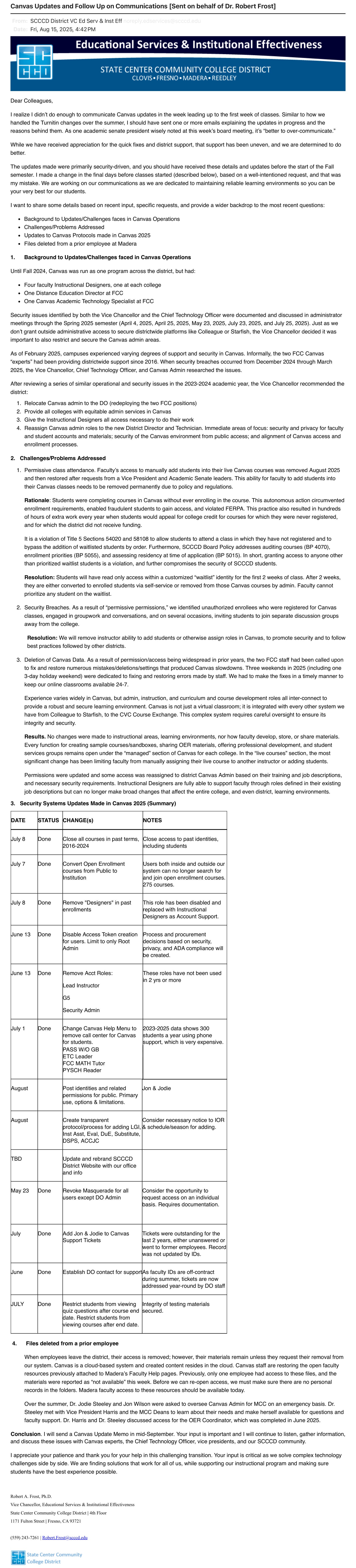
The changes stripped faculty of long-standing permissions, removed Instructional Designers’ (IDs’) administrative access, deployed a “waitlist” identity at three of the four colleges, and reorganized Canvas support to route everything through the District Office and, effectively, through Steeley. As we will explore, the permission change was not security-driven. It was designed to route decisions to the District Office and, chiefly, to justify Steeley’s position—a position that should not exist.
By the first week of Fall 2025, IDs’ permissions had been removed without notice. They could no longer perform the basic support functions central to their role. Faculty could not add tutors as they had before; the new waitlist function generated campuswide enrollment confusion; and help tickets routed to Steeley’s office were backlogged for days at a time. By mid-September, the FCC, RC, and MCC Academic Senates had all placed Canvas concerns at the top of their agendas.
Both the September 9, 2025 District Canvas meeting and the September 12, 2025 MCC Academic Senate meeting gave Steeley a face-to-face opportunity to explain. She took both opportunities. But what she said in each was deceptive and became, by faculty consensus across three colleges and the faculty union, the centerpiece of the case against her.
5. Steeley’s Own Words
5.1. District Canvas Meeting—September 9, 2025
On September 9, 2025, Deputy Chancellor Christine Holt-McDonald convened a districtwide Canvas meeting. The room included Goldsmith herself, Frost, Lopez, Steeley, Academic Technology Systems Specialist Jon Wilson, and nearly every Vice President of Instruction, Senate President, Distance Education Coordinator, and Instructional Designer from all four colleges. In total, 25 people participated. The purpose, per Holt-McDonald’s framing at the start of the meeting, was to “develop a path for going forward” on the Canvas changes that had upended the start of Fall instruction. The PDF below contains the official minutes from the meeting, but those minutes miss important exchanges. [PDF below]

Everyone introduced themselves at the start of the meeting. When it was her turn, Steeley said:
“Hi. And I’m Dr. Jodie Steeley. I’m the District Director of Distance Education and Instructional Technology. It’s nice to see you all in person. Too much is online.”
She said that in front of twenty four other participants (her statement becomes important later in the article).
After the introductions, Goldsmith made a statement before leaving. She addressed what she called the public confusion about Steeley’s and Wilson’s roles. She wanted to “set the record straight.” What followed is best read in her own words:
“These are not new positions. They were moved. Very similar to what we did when we first got here... So I just kind of wanted to come back and tell everybody these are not new positions. These are moved positions.”
A reader could be forgiven for taking that as a clear position statement. Less than a minute later, in the same statement, Goldsmith continued:
“In talking with the college making this move back in December of last year, it was not permanent. It was also like let’s do some work and then reassess.”
In the same breath, Goldsmith described the position as four different things. She insisted the position was not new, but also not permanent, but also a move, but also something to “reassess.”
Each of those is incompatible with at least one of the others. A position that has merely been “moved” does not require reassessment. A placement that is “not permanent” cannot also be a structural relocation of an existing role. A position that is “not new” cannot be a pilot. Goldsmith’s framing was contradicted by the rest of Goldsmith’s framing.
Goldsmith also identified herself as the originator of the move. She said:
“I asked Dr. Dunn to work with the college. We wanted to move these two positions to provide district support and backbone.”
The directive, in Goldsmith’s own telling, was hers. She decided. She asked a subordinate to work it out with the college. The position that was never posted, never reviewed by a Selection Advisory Committee, and never approved by the Board was, by the Chancellor’s own September 9 acknowledgment, hers to create.
Goldsmith left after making a very telling statement:
“I’m going to run because I know sometimes, believe it or not, sometimes with my presence in the room, people actually don’t speak as freely.”
Then Steeley described two security incidents: the “Patel case” and a Reedley student whose account had been compromised. Those incidents mattered. But the central problem came when Steeley and Wilson’s own explanations separated the security incidents from the permission changes imposed on faculty and Instructional Designers.
When MCC Academic Senate President Todd Kandarian asked whether disabling access tokens in March had restricted local Instructional Designers’ access or whether that came later, Wilson clarified that there were “two different animals.” One was the Canvas settings, which had been changed for security reasons. The other involved user permissions that had been changed, including Instructional Designers’ administrative permissions. When Kandarian pressed Wilson on whether the permission changes were associated with the token issue that had caused security problems, Wilson answered:
“No, no, no, no.”
The access-token issue was a security issue. The permission removals were a different “animal.” Yet Steeley’s explanations and Frost’s August 15 email deceptively collapsed both into a single security-coded narrative.
Then came Steeley’s most revealing claim, one that faculty have heard her make in multiple settings in relation to the Canvas role debacle. She said:
“The changes that happened in managing Canvas were initiated by the instructional designers when they asked to have a separation of the technology part and the pedagogy part.”
The room almost erupted in opposition. The Instructional Designers in the room all shook their heads in opposition to Steeley’s statement. The FCC Academic Senate President Karla Kirk said:
“It’s not coming from my instructional designer. She is sitting right here.”
The RC Academic Senate President Rebecca Snyder put it even more pointedly:
“My instructional designer wanted me to specifically say that’s not true.”
Steeley then made another false claim. She said, referring to Instructional Designers:
“They went to their vice presidents and got approval for this division, and that’s why the district group disbanded in February. It’s because they were going to have their own.”
Both Kirk and CCC Academic Senate President Max Hembd noted that the college vice presidents sitting in the room were visibly disagreeing. Both said:
“The VPs are shaking their heads no.”
The September 9 meeting was Steeley’s opportunity to course-correct. She did not. Instead she doubled down. Instructional Designers, Academic Senate Presidents, DE Coordinators, and Vice Presidents of Instruction from every college in the District contradicted her on the record, in the same room, in real time. Three days later she made the same claims again at MCC’s Senate meeting.
5.2. MCC Academic Senate Meeting—September 12, 2025
The September 12, 2025 MCC Academic Senate meeting was Steeley’s opportunity, in her own words and in front of a faculty governance body, to address the concerns that had been raised. She took it and made eight specific claims about her title, her authority, the origins of the Canvas changes, and the reasoning behind them.
Each is contradicted by primary documents already in the record. What follows is the catalog.
Claim 1: “District” is not in her title.
Steeley asked that the word “District” be removed from her title on the Senate agenda, telling the body that her title was unchanged from her FCC appointment.
The documentary record contradicts her on six separate fronts.
Three days earlier, on September 9, she had introduced herself to twenty-four faculty leaders and administrators, including her direct supervisor, Frost, and Frost’s supervisor, Goldsmith, as “Dr. Jodie Steeley, the District Director of Distance Education and Instructional Technology.”
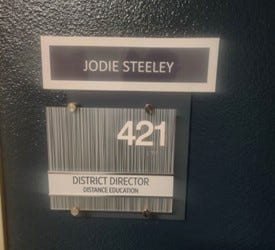
The nameplate on her office door at the District Office identified her as “District Director.” [image below]
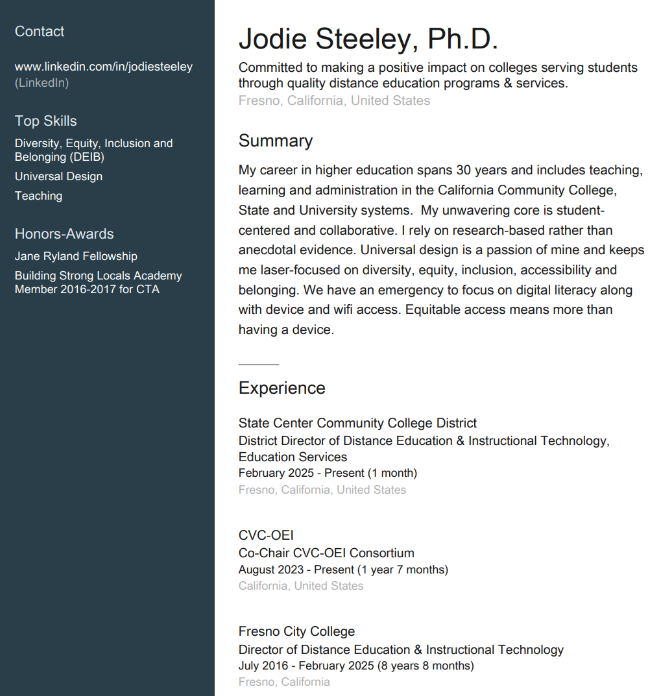
Her LinkedIn profile listed her position as “District Director.” [image below]

Her CV on LinkedIn had her title as “District Director.” [image below]
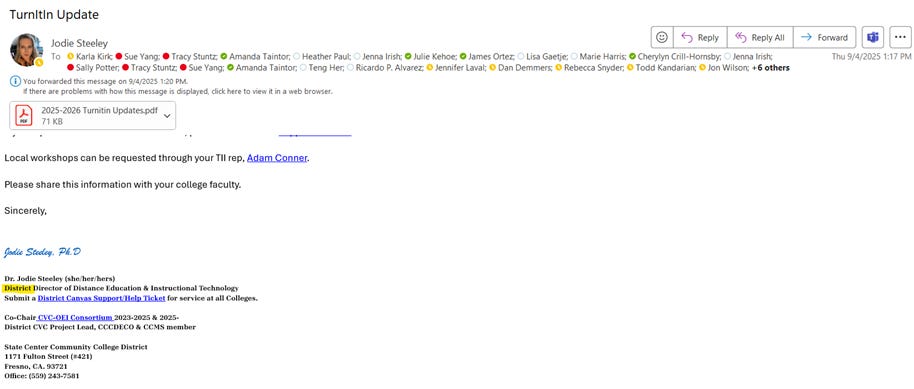
Her own email signature on official communications read, “District Director.” [image below]
And six months later, when Goldsmith herself appeared before the RC Academic Senate, she referred to Steeley as the District Director.
Claim 2: The Instructional Designers asked for it
Steeley repeated her claim that the Instructional Designers had requested the removal of their own Canvas permissions. This was the same rebuffed claim she had made three days earlier at the September 9 District Canvas meeting.
It was not true then. It is not true now.
Claim 3: The two security incidents justified permission removal
Steeley again cited two security incidents—a malware-related case involving a student known in District communications as the “Patel case,” and a compromised student account belonging to an RC student—as justification for the changes to IDs’ permissions.
Neither incident involved IDs’ permissions. One was a malware exploit. The other was a compromised student account. Neither was caused by faculty access, and neither was solved by stripping IDs’ access.
Jon Wilson was specifically asked about this at the September 9 meeting, and he denied any connection, saying they were “different animals.” The District’s own technical specialist had already separated the two issues on the record three days earlier. Steeley falsely fused them again.
Claim 4: RC’s head of technology Dan Demmers
Steeley claimed that Dan Demmers, RC’s head of technology, told the RC student to change her password. According to email records, Steeley made that recommendation; Demmers identified the issue as more serious. This misattribution was flagged at the September 9 meeting by Snyder, but Lopez ran to Steeley’s defense and became aggressive about the assumptions he believed RC Senate President Rebecca Snyder was making. Neither correction has been formally entered into the District record by Steeley.
Claim 5: The MCC tutor role
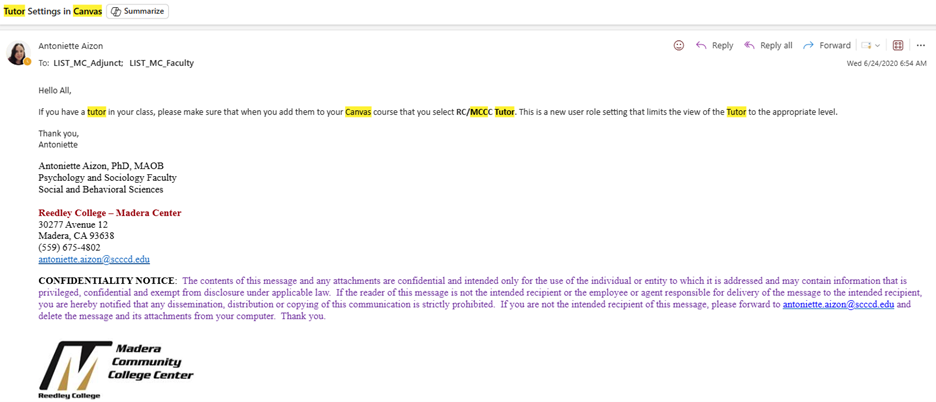
Steeley falsely claimed that the MCC tutor role was created by her in collaboration with MCC tutorial coordinator Mr. Ray Sanchez. The MCC tutor role had existed and been in use since at least June 24, 2020—five years before Frost’s August 15, 2025 email claimed that the tutor role for all colleges was created on July 25, 2025. The role had been collaboratively designed by MCC faculty during the pandemic. Steeley made this claim during a window of the meeting when Sanchez had stepped out of the room and could not respond. [image below]
Claim 6: The FCC observer role
Steeley also claimed that the FCC Academic Senate had voted to make the waitlist role’s “observer” mode the default. In fact, the FCC Senate had voted the opposite way in Spring 2025 to allow faculty to manually add waitlisted students if they chose, not to enroll every waitlisted student automatically as an observer.
Once the Instructional Designers’ administrative access was removed, Steeley reversed the observer role to the version the FCC Academic Senate had rejected and then deployed it across the other three colleges without consultation, notably over the recorded objections of the Vice Presidents of Instruction.
Claim 7: Her qualifications
Steeley claimed she was qualified to make Canvas decisions on behalf of all four colleges. When asked about her Canvas qualifications, Steeley discussed her doctoral work, her past distance education coordinator role at Merced, her role on the CVC consortium, and her general experience in the field. She did not, in the entirety of her response, name any specific Canvas-related qualification. She has acknowledged elsewhere that she has never taught using Canvas. MCC Senate member Lynette Cortes-Howden pressed her on this directly:
“I’m not hearing a lot of the Canvas experience.”
Claim 8: Nothing is ever deleted
In response to faculty concerns about lost access to materials following the deactivation of former MCC Instructional Designer Erin Heasley’s account, Steeley assured the Senate:
“Nothing is ever deleted from Canvas.”
Reportedly, Heasley’s successor, Dr. Antoniette Aizon, had a documented transition plan with Heasley that depended on Aizon’s continued access to Heasley’s materials. The deactivation of Heasley’s account broke that plan. By Frost’s own August 15 email, materials previously attached to Madera’s faculty help pages were “reported as not available” and required staff intervention to restore.
The phrase “nothing is ever deleted” may be technically accurate at the Canvas cloud level. It is not accurate at the user-experience level, which is the only level that matters to a faculty member trying to access teaching materials. The distinction was never explained.
Steeley stood before a faculty governance body, identified the meeting as her opportunity to address concerns, and made eight specific claims. Each was contradicted by primary documents already in the District’s own record.
The Holt-McDonald reversal followed five days after this meeting. Whatever the District’s internal calculus, the public timeline shows a pattern. When Steeley appeared and made her case, the District retreated.
6. The Reversal
The Holt-McDonald reversal on September 17, 2025, was the most significant District-level retreat from a Steeley action to date. It is also the first sign that her protection arrangement may have begun to fail.
In the email, sent the evening of September 16, 2025, to all District Canvas stakeholders, Holt-McDonald—then newly in office as Deputy Chancellor—announced that “permissions for Instructional Designers (IDs) at each college will be reinstated on an interim basis effective Wednesday, September 17.” All permissions were restored except masquerade access. The email further instructed that nine specific actions—including “deleting or creating new roles/permissions” and “assigning Canvas admin to other users”—were not to be performed in live courses without consultation with the District Canvas Admin. [image below]
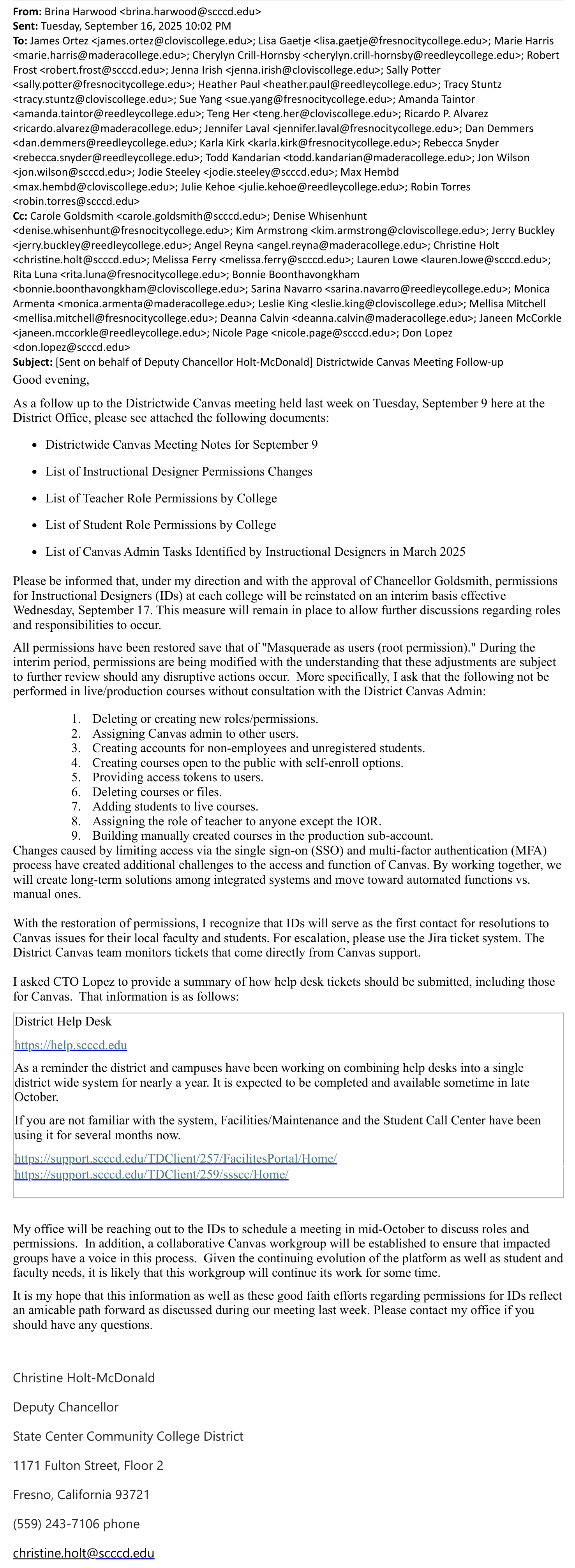
The list of nine restrictions is itself revealing. Reportedly, IDs have never done most of the listed actions. The constraints were performative. The substance of the email was the reversal.
7. A Word for Supporters
Administrators, we warned that we would knock on your doors for any malfeasance you committed. We are delivering on that promise, just like every other promise we have made. It is not a question of if we will write about you, but when. When you acted, you thought you had impunity. You may remain insulated from employment consequences for a few more months, but you will not be insulated from public transparency.
Future workers and the public deserve a digital record of how Goldsmith and her cronies damaged our District. Our articles serve as the historical record that future workers and leaders rely on to avoid repeating what Goldsmith did.
We continue to ask: look in your circles for retired SCCCD faculty or classified professionals. Current K-12 teachers in unified school districts across our service area may also serve on the SCCCD Board of Trustees while continuing to teach. The political hacks currently masquerading as trustees are running this District into the ground. Their replacements will determine whether what comes next is recovery or further decline.
If you are interested in running, or know someone who is, contact us at SCCCDInsiders.Press@proton.me.